
The final year of university often feels like a high-stakes race where the finish line keeps moving. For most students, the dissertation is the largest, most complex project they have ever faced. It isn’t just about the word count; it’s about the mental weight of original research and the looming fear of a hard deadline. This “dissertation stress” is a recognized psychological phenomenon that can lead to total burnout if not managed with a clear, evidence-based strategy.
Understanding the science of stress is the first step toward conquering it. When you feel overwhelmed, your brain’s “fight or flight” response takes over, making it nearly impossible to focus on complex academic synthesis. To regain control, many students find that shifting the heavy administrative or formatting load to professional Assignment Help Online through platforms like myassignmenthelp allows them to refocus their mental energy on their core research and analysis. By offloading the smaller hurdles, you can prevent the paralyzing “freeze” response that often happens three weeks before a deadline.
The Psychology of Academic Procrastination
Science tells us that procrastination isn’t about being lazy; it’s about emotional regulation. We avoid the dissertation because it makes us feel anxious. To break this cycle, you need to use “Micro-Goal Setting.” Instead of writing “Work on Chapter 1” on your to-do list, write “Draft 200 words for the introduction.” Small wins release dopamine, which actually fuels your brain to keep going.
Building a “Deep Work” Schedule
High-achievers don’t work 10 hours a day; they work in concentrated bursts. Research by Cal Newport suggests that “Deep Work”—distraction-free concentration—is the only way to produce high-quality academic writing.
- The 90-Minute Rule: Your brain can only maintain peak focus for about 90 minutes. Set a timer, put your phone in another room, and write.
- The “Shitty First Draft” Principle: Perfectionism is the enemy of the deadline. Get your ideas on paper first. You can always edit a bad page, but you cannot edit a blank one.
Leveraging External Academic Resources
As the submission date approaches, the technical requirements for citations and literature reviews become a massive source of anxiety. If you find yourself stuck on the structural elements of your paper, seeking specialized Dissertation Help can provide the clarity needed to organize your findings effectively. Having a second pair of eyes or a professional template can be the difference between a passing grade and a distinction.
4. Creating a Science-Backed “Burnout Shield”
To stay productive over several months, you must treat your brain like an athlete treats their body. Stress management isn’t a luxury; it is a functional requirement for ranking high in your class.
- Cognitive Reframing: Instead of saying “I have to finish this,” say “I am choosing to explore this topic.” This small shift reduces the “threat” response in your amygdala.
- The Power of Nap: Studies show that a 20-minute power nap can improve cognitive function and memory consolidation—vital when you are trying to remember 50 different sources for a literature review.
- Active Recovery: Walking in nature for just 15 minutes has been shown to lower cortisol levels significantly. If you are stuck on a paragraph, go outside.
Managing the Technical “Late-Stage” Panic
The last 10% of a dissertation usually takes 50% of the effort. This is where the formatting, table of contents, and bibliography management happen. Most students underestimate this phase, leading to a “panic-sprint” in the final 48 hours.
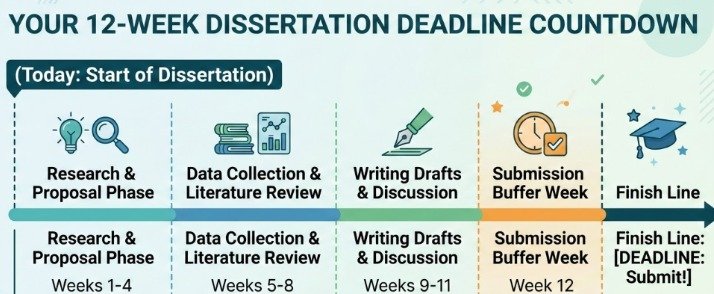
To avoid this, create a “Technical Buffer.” Your writing should be finished at least five days before the deadline. Use those final five days exclusively for proofreading, checking for “Academic Integrity,” and ensuring your “Research Methodology” is clearly explained. This buffer acts as a safety net for unexpected tech issues or last-minute printer failures.
Frequently Asked Questions
- How can I manage overwhelming academic stress?
The most effective approach is “Micro-Goal Setting.” Break your massive project into tiny, manageable tasks—like writing just 200 words at a time—to trigger dopamine and maintain steady momentum.
- What is the best way to meet tight deadlines?
Use a “Reverse Calendar” strategy. Start at your submission date and work backward to assign specific sections to each week, ensuring you leave a five-day buffer for final technical checks.
- Is it possible to improve focus during long writing sessions?
Yes, by using the “90-Minute Rule.” Science shows human concentration peaks for about an hour and a half; schedule high-intensity writing bursts followed by short, active breaks to refresh your brain.
- How do I handle a writer’s block during research?
Switch to “Zero Drafting.” Ignore grammar and citations to simply get your core ideas on paper. It is much easier to edit a messy page than it is to start from a blank screen.
About The Author:
I am Cooper Robinson, a dedicated content strategist and educational consultant at myassignmenthelp. I am passionate about bridging the gap between complex academic requirements and student success through clear, insightful, and actionable storytelling.