Gift-giving has changed. The generic boxes of chocolates, the standard bouquets, the off-the-shelf perfume — they still appear, but they no longer feel like enough. In a world where almost anything can be ordered with a click and arrive within hours, what we want from a gift is no longer convenience. It’s intention. And in 2026, no category captures that intention better than personalized jewelry.
Here’s why personalized pieces have become the defining gift of the decade — and why they’re likely to stay that way.
The Psychology of Personalization
Researchers studying gift-giving have long noted that the most memorable gifts share three traits: they’re specific to the recipient, they require thought to choose, and they carry emotional weight beyond their material value. Personalized jewelry hits all three. A necklace engraved with a date, a name, or a coordinate doesn’t just commemorate something — it commemorates a specific something. Every time the recipient looks at it, the meaning is encoded into the object itself. That’s a powerful difference from a generic gift, no matter how expensive.
From Niche to Mainstream
Ten years ago, personalized jewelry was largely confined to monogrammed necklaces and engraved bracelets sold in specialty boutiques. Today, it’s mainstream — driven by digital design tools that let buyers preview customizations in real time, lower minimum-order requirements that make custom pieces accessible at every price point, and a generation of consumers who genuinely prefer specific to generic. The market has grown roughly threefold in the last five years, and the pace shows no sign of slowing.
What ‘Personalized’ Actually Includes
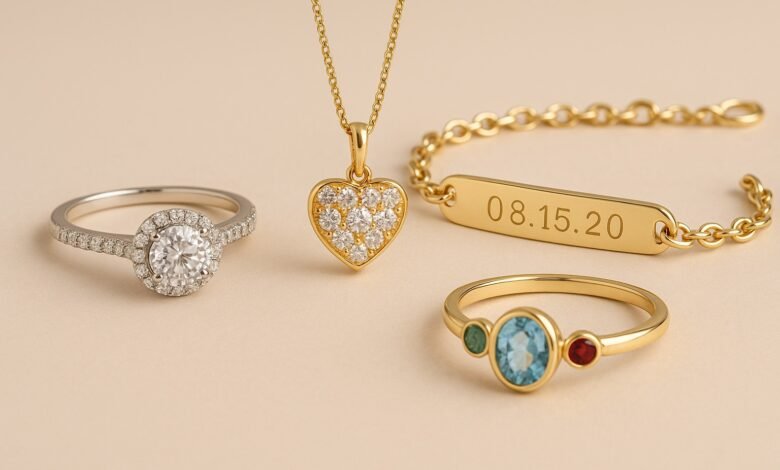
The term covers more ground than most people realize. Engraved pieces — names, initials, dates, short phrases — remain the most popular category. Birthstone jewelry, which combines a personal element (the wearer’s or a loved one’s birth month) with traditional design, has surged in the last three years. Coordinate jewelry, where a meaningful location is etched into a pendant, has carved out its own niche. Photo lockets, modernized with laser-engraved silhouettes, have moved from sentimental to genuinely stylish. And bespoke designs — where the buyer collaborates with a designer on a one-of-a-kind piece — have become more accessible thanks to digital design tools.
Among all of these, personalized necklaces remain the most popular entry point, partly because they’re the easiest to wear daily and partly because they translate so naturally into meaningful gifts for partners, mothers, sisters, and friends.
Why It Matters More Than the Price Tag
The economics of personalized jewelry are interesting. A gold pendant that costs $80 but carries a meaningful inscription often outperforms a $400 generic piece in emotional impact and long-term wear. Recipients keep personalized jewelry longer, wear it more often, and treasure it disproportionately to its retail value. This isn’t sentimental marketing language — it’s measurable consumer behavior. Personalization changes the relationship between the wearer and the object.
How to Choose a Personalized Piece
Start with the wearer. Are they minimalist or maximalist in their daily style? Do they wear gold or silver? Do they have any pieces they wear constantly that you can use as a reference? The most successful personalized gifts feel like they belong in the recipient’s existing wardrobe — not like they’re competing with it. Match the metal, scale, and finish to what they already wear. Then choose what to engrave. The most meaningful inscriptions are specific: a date, a name, a short phrase that means something only to the two of you. Avoid generic words like ‘love’ or ‘forever’ on their own — they dilute the personalization that makes the gift work in the first place.
The Mistakes to Avoid
Three pitfalls trip up most first-time buyers. First, choosing a piece that’s stylistically wrong for the wearer — a delicate engraved pendant doesn’t suit someone who lives in chunky statement jewelry, and vice versa. Second, over-engraving — long quotes or multiple inscriptions on a small piece make it look cluttered. Less almost always reads better. Third, leaving the personalization to the last minute — most reputable brands need 7 to 14 days to engrave and ship, and rushed jobs show in the finished product.
The Long-Term Value
Generic jewelry depreciates emotionally over time. A standard necklace gifted today may sit in a drawer five years from now. Personalized jewelry tends to do the opposite — it gains meaning with the years, especially as the moments it commemorates fade further into memory. A locket from a tenth anniversary becomes more meaningful at the twentieth. A coordinate pendant from a couple’s first home becomes more layered after they’ve moved several times. The piece accrues meaning the way nothing mass-produced can.
Why It Will Stay
Trends in gift-giving come and go, but the move toward personalization isn’t really a trend. It’s a structural response to a world where almost everything else is generic, fast, and disposable. People want gifts that say something. They want gifts that can’t be replicated. They want gifts that carry their relationships in them. Personalized jewelry does all three — and that’s why it’s likely to remain the most meaningful gift category for the foreseeable future.