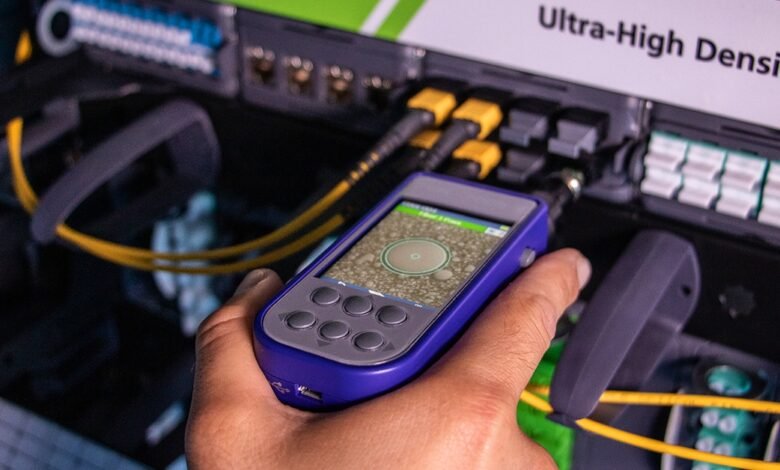
You cleaned the connector. You inspected it with a handheld scope. It looked clean. You plugged it in. The link came up. Then it started dropping packets. Intermittent. Infuriating. The problem was a scratch too small for your scope to resolve. That scratch scattered light. Enough light passed for the link to initialize. But the scattered light created a high bit error rate that caused intermittent failures. A proper MTP loopback for diagnostic use includes reference-grade connectors with documented insertion loss and return loss. The manufacturer measures each connector with an interferometer. They certify the surface finish. They reject any connector with scratches, pits, or chips. Your field scope cannot see those defects. The manufacturer’s lab equipment can. Ask your loopback supplier for the interferometry report on each module. If they cannot provide one, their connectors are not reference-grade. Your diagnostics will be contaminated by connector problems that you mistake for switch or transceiver problems. That is not testing. That is guessing with expensive equipment.
The Angled Polish Confusion That Creates An Air Gap
Multimode fiber uses flat polish. Singlemode fiber often uses angled polish. Angled connectors reduce back reflection. They also require mating with other angled connectors. An angled polish mated to a flat polish leaves an air gap. Light escapes. Loss increases. Your MTP loopback must match the polish type of your system. A loopback with angled polish will fail when plugged into a flat-polished adapter. Not because anything is broken. Because the angles do not match. Ask your supplier about the polish type. If they say “universal,” they are mistaken. There is no universal polish. There is only correct and incorrect. Your fiber plant uses one polish type. Your loopback must use the same type. Verify this before you order. A mismatched polish will create link loss that sends you searching for problems that do not exist. Your time is too valuable for that detour.
The Insertion Loss Accumulation That Kills Your Link Budget
Every connection adds loss. Your patch panel adds loss. Your transceiver adds loss. Your loopback adds loss. Add them all together. That total must stay within your link budget. A high-loss MTP loopback may push your test link over the budget even when every component is within spec. You will see link failures. You will blame the transceiver or the switch. The real problem is the loopback’s insertion loss is too high for your test configuration. Ask your supplier for the maximum insertion loss specification. Look for numbers below 0.5 dB for a single mated pair. If the spec is 1.0 dB or higher, that loopback will eat your link budget. Use it only for very short, low-loss test setups. For realistic testing, choose a low-loss loopback that adds minimal insertion loss. Your test results should reflect the performance of your system, not the performance of your test tool. A lossy loopback corrupts that reflection.
The Retimer Chip That Hides Real Transceiver Problems
Some active loopback modules contain retimer chips. They clean up the signal. They resample it. They output a pristine copy of what they received. That is useful for some tests. It is terrible for testing transceivers. A noisy transceiver output that would fail in a real system will pass when plugged into a retimed loopback. The retimer fixes the noise. You think the transceiver is good. You install it in production. It fails. Your MTP loopback lied to you. Passive loopbacks have no retimer. The signal goes in and comes out with no cleaning. What you send is what you get back. That is honest testing. Ask your loopback supplier whether their module contains a retimer. If the answer is yes, ask how to disable it. If you cannot disable it, buy a passive loopback for transceiver testing. Active loopbacks have their place. Transceiver characterization is not that place. Honest testing requires a passive electrical and optical path. No retimers. No signal conditioning. Just the raw, unfiltered signal that your system will actually see.
The Power Draw Surprise That Overloads Your Switch
Active loopback modules draw power. Some draw significant power. Your switch has a power budget for its ports. Plugging a high-power active loopback into a port may exceed that port’s power allocation. The switch disables the port. You cannot run your test. Or worse, the switch disables the entire line card because of an overcurrent condition. Your MTP loopback should specify its maximum power draw. Look for modules that draw less than 1.5 watts for passive loopbacks and less than 3.5 watts for active loopbacks. If the datasheet does not list power consumption, assume it is high. Ask the supplier. If they cannot answer, find another supplier. A loopback that crashes your switch is not a diagnostic tool. It is a liability. Your time spent rebooting switches is time you are not spending finding real problems. Keep your loopbacks low-power and your switches online.
The One Certification That Separates Lab Tools From Field Toys
Look for a calibration certificate. Not a certificate of conformance. A real calibration certificate with actual measured values for insertion loss, return loss, and per-lane skew. That certificate should be traceable to a national standards laboratory. NIST in the United States. PTB in Germany. Each MTP loopback you buy should come with its own unique calibration data. No two modules are identical. The certificate proves that your specific module was measured on a known-good reference system. Ask your supplier for a sample certificate before you order. If the certificate lists the same values for every module, it is not a real calibration. It is a printed guess. A real calibration has variance. Each module has slightly different measured values. Those values are your baseline for future testing. When your loopback’s performance drifts, you compare current measurements to the original certificate. That drift tells you when to clean, repair, or replace the loopback. Without a baseline, you have no idea whether your test tool is still accurate. Your network deserves calibrated test equipment. Your loopback should meet that same standard. Demand the certificate. Keep it on file. Test with confidence instead of hope.