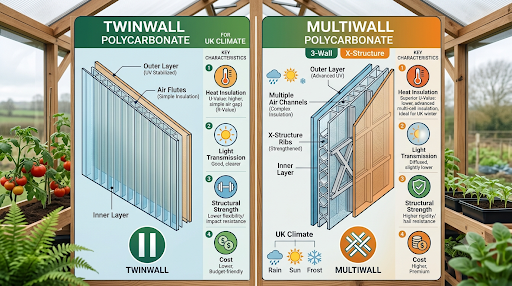
The choice between twinwall and multiwall comes down to how much insulation your greenhouse actually needs. All polycarbonate greenhouse panels share the same hollow-channel design. However, they vary in thickness and layers.
Twinwall sheets suit lighter growing setups. On the other hand, thicker multiwall sheets hold heat for demanding crops. Understanding that difference helps UK growers glaze a greenhouse that performs year after year.
What Is the Difference Between Twinwall and Multiwall?
The difference lies in the number of internal walls and the trapped air between them. A greenhouse polycarbonate sheet uses hollow channels to hold air, and that air is what insulates. Twinwall has two layers with a single air gap between them. Multiwall adds more layers, which creates extra air pockets for stronger insulation.
More layers mean better heat retention, but also a higher price and weight. Twinwall is lighter and cheaper, which makes it suitable for smaller or seasonal greenhouses. Multiwall rewards growers who run their space through cold winters.
Here is how the two compare at a glance:
| Feature | Twinwall | Multiwall |
| Layers | Two, single air gap | Three or more, multiple gaps |
| Insulation | Good | Excellent |
| Weight | Lighter | Heavier |
| Typical thickness | 4mm to 10mm | 16mm to 35mm |
| Best for | Seasonal growing | Year-round growing |
Neither sheet is simply better, since each answers a different growing need. Your climate and crop plan point you toward the right one.
Which Option Insulates a UK Greenhouse Better?
Multiwall insulates better because its extra air pockets slow heat loss far more. A thicker greenhouse polycarbonate sheet keeps overnight warmth inside during frosty British winters. That stability protects tender plants from sharp drops in temperature after dark.
Twinwall still insulates well for most of the growing season. It holds enough warmth for spring sowing and summer growing without issue. Many hobby growers find it perfectly suited to their needs.
The gap shows most clearly in the coldest months. Consider what each sheet handles comfortably:
- Twinwall suits spring through autumn, growing in milder regions
- Multiwall holds heat for winter crops and frost-prone areas
- Both cut heating costs against single-glazed glass alternatives
Growers in Scotland or exposed sites lean toward multiwall for that reason. Those in sheltered southern gardens often manage well with twinwall.
How Much Light Do Polycarbonate Panels Let Through?
Light transmission drops slightly as the thickness and the number of layers increase. Twinwall polycarbonate panels for greenhouse use let through a high level of diffused light. That diffusion spreads sunlight evenly, reducing scorching on delicate leaves.
Multiwall passes a little less light because of its added internal walls. The trade is gentler, with more even light against marginally lower total brightness. For most crops, this difference barely registers in real growing results.
Diffused light actually helps plants more than harsh direct sun. It reaches lower leaves, which are often left in shadow by direct glass glazing. Both sheet types deliver this benefit across the whole canopy.
Which Sheet Suits Your Type of Growing?
Your crops and growing calendar determine which sheet serves you best. Choosing polycarbonate sheets for greenhouse projects starts with how you actually grow. A summer salad grower and a winter tomato grower need different specifications.
Match the sheet to your growing style using these pointers:
- Seasonal hobby growing: twinwall gives warmth and light at a lower cost
- Year-round production: multiwall protects crops through the coldest spells
- Exposed or northern sites: multiwall handles wind and frost with ease
- Sheltered southern plots: twinwall covers most needs comfortably
Twinwall polycarbonate sheets work brilliantly for growers starting. They keep costs down while still outperforming old-fashioned glass panes. Upgrading later to thicker glazing always remains an option.
Multiwall polycarbonate sheets suit serious growers with year-round ambitions. The stronger insulation pays off in healthier winter crops and lower heating costs. Both belong in a well-planned UK greenhouse.
Do Both Options Last Well in British Weather?
Yes, both twinwall and multiwall stand up to years of UK weather. Quality polycarbonate greenhouse panels carry co-extruded UV protection fused into the surface. This layer guards against yellowing and keeps the panels clear for longer.
Twinwall polycarbonate sheets resist hail, wind, and heavy rain without cracking. Multiwall polycarbonate sheets add extra rigidity for wider spans and exposed roofs. Both far outlast glass, which shatters under a stray football or storm.
Fixing matters as much as the sheet you choose. Panels cut to your exact greenhouse dimensions reduce gaps and weak points. A precise fit keeps warmth in and weather out for many seasons.
Making Your Final Choice
Your final choice rests on climate, crops, and how far your budget stretches. Twinwall gives light, warmth, and value for seasonal and hobby growing. Multiwall delivers stronger insulation for year-round and cold-weather production.
Neither sheet wins outright, since the best glazing matches your own greenhouse. Measure your space, weigh your growing goals, and pick the thickness that fits. A little planning now rewards you with thriving plants for years.
FAQs
Is twinwall or multiwall polycarbonate better for a greenhouse?
Neither is better, as each suits a different growing need. Twinwall is suited to seasonal growing, while multiwall handles year-round and cold-weather crops.
How thick should greenhouse polycarbonate panels be?
Twinwall panels usually run from 4mm to 10mm for lighter setups. Multiwall panels range from 16mm to 35mm for stronger insulation.
Do polycarbonate panels for greenhouse use block sunlight?
No, they let through high levels of diffused light instead. This even light reaches lower leaves that direct sunlight often misses.
How long do polycarbonate sheets for greenhouse projects last?
Quality sheets with UV protection last many years in UK weather. Co-extruded protection guards against yellowing and keeps panels clear over time.
Can polycarbonate replace glass in an existing greenhouse frame?
Yes, most standard frames can take polycarbonate with minor adjustment to the fixing. The lighter sheets ease strain on the frame and resist storm damage far better.
Do greenhouse polycarbonate sheet panels cause condensation inside?
Some condensation is normal, though good ventilation keeps it under control. Anti-drip coatings on certain panels channel moisture away from your plants.
Can I cut polycarbonate sheets to fit my greenhouse myself?
Yes, you can trim them with a fine-tooth saw and a steady hand. Ordering panels cut to size, though, removes the guesswork and gives a cleaner fit.
READ ALSO: Hair Transplant in the Netherlands: A Complete Patient Guide