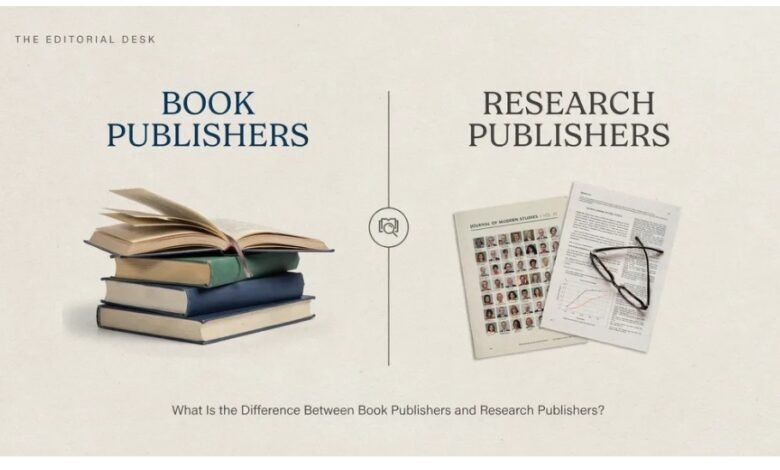
Publishing looks simple from the outside: someone writes something, someone publishes it, and the world gets to read it. Nice and tidy, right? Not quite.
A novelist trying to release a memoir, a PhD scholar preparing a journal article, and a medical researcher aiming for Scopus indexing are not chasing the same finish line. They may all search for publishers, but the type of publisher they need is completely different.
That is where many writers get stuck. They search for the best book publishers, click through a few websites, and quickly realise half the results are about novels, biographies, and children’s books, while the other half talk about journals, citations, indexing, and peer review. Same word. Different world.
So, what exactly separates book publishers from research publishers? More importantly, which one should an author, student, or researcher choose?
Book Publishers Focus on Readers and the Commercial Market
Book publishers work with manuscripts written for readers. That includes fiction, nonfiction, memoirs, poetry, business books, self-help books, children’s books, and educational titles.
Their main job is to turn a manuscript into a finished book that looks professional, reads smoothly, and can be sold through the right channels. A good book publisher usually helps with editing, proofreading, formatting, cover design, ISBN guidance, printing, ebook conversion, and distribution.
For authors in the UK, this can be especially useful when they want to publish a book online in the UK but do not know where to start. The process can feel a bit mad at first: manuscript files, cover sizes, Amazon listings, copyright pages, metadata, blurbs, author bios, and pricing. A proper publishing team keeps all of that organised.
The best book publishers do more than print pages. They shape a book so it can compete in the market. They think about the reader, the genre, the book description, the title, and the buying journey.
Research Publishers Focus on Academic Credibility
Research publishers operate in a more academic space. Instead of helping someone publish a novel or memoir, they deal with research papers, journal articles, theses, dissertations, conference papers, medical manuscripts, and scientific studies.
The goal here is not just to attract readers. The goal is credibility.
A researcher usually wants their work published in a recognised academic journal, preferably one linked with respected databases such as Scopus, Web of Science, or ISI-indexed journals. Scopus and Web of Science are widely used citation databases in academic research evaluation, which is why researchers often care about where their work is indexed.
This is where services such as Research Paper Publishing Services become relevant for scholars who need structured academic publication support rather than general book production.
Research publishing often includes manuscript assessment, journal selection, formatting according to journal guidelines, plagiarism checks, citation correction, language polishing, peer review preparation, and submission support. Some researchers may also look for Scopus Publication Support or ISI Journal Publication Services when their academic targets require indexed publication.
The Review Process Is Completely Different
Book publishing and research publishing both involve review, but the review style is not the same.
In book publishing, the review is usually editorial and commercial. Editors look at the story, structure, clarity, pacing, grammar, market appeal, and reader experience. If the book is a business guide, they check whether the ideas are clear and useful. If it is fiction, they look at plot, characters, dialogue, and flow.
Research publishing is stricter in a different way. A journal paper may go through peer review, where academic experts examine the research question, methodology, evidence, references, originality, and ethical standards. Recent academic publishing discussions also place strong emphasis on technical quality, structure, writing precision, and research integrity.
That is why a polished writing style alone is not enough for research publication. The paper must meet academic expectations.
Self-Publishing Belongs Mostly to the Book World
A self-book publisher or assisted self-publishing service is usually designed for authors who want more control. They may not want to wait months for a traditional publisher. They may want to keep more rights, publish faster, or test their book idea directly with readers.
This is where searches like self book publishing uk or book publishers online become common. UK authors often want a practical route: upload the manuscript, get it edited, design the cover, format the book, and make it available online.
Self-publishing works well for many authors, but it still needs professional handling. A weak cover, messy formatting, or badly written blurb can make even a strong book look amateur. No one wants that after months, or years, of writing.
Research publishing does not work in the same free-form way. A scholar cannot simply “self-publish” a research paper and expect it to count as a peer-reviewed journal publication. Academic publishing depends on journal standards, indexing, editorial checks, and review procedures.
The Audience Changes Everything
Book publishers think about readers.
Research publishers think about reviewers, academics, institutions, and citation value.
That difference changes the whole strategy. A romance novel needs an emotional hook. A leadership book needs a strong promise. A children’s book needs age-appropriate language and visuals. A medical research paper needs accuracy, evidence, references, structure, and journal compliance.
For books, success may mean sales, reviews, visibility, and reader engagement.
For research, success may mean journal acceptance, indexing, academic recognition, institutional value, and future citations.
Both matter. They just serve different goals.
Which Publisher Should Someone Choose?
The answer depends on the work.
If someone has written a novel, memoir, business book, poetry collection, children’s book, or nonfiction manuscript, they should look for book publishing support. They need editors, designers, formatters, publishing consultants, and distribution guidance.
If someone has written a research paper, medical article, thesis-based manuscript, scientific study, or journal article, they need research publishing guidance. They should look for academic editing, journal matching, formatting, citation support, and indexed publication assistance.
The biggest mistake is choosing a publisher only because the website looks professional. Writers and researchers should check what the publisher actually specialises in. A brilliant book publishing team may not be the right fit for Scopus journal submission. A research publication service may not be ideal for launching a fantasy novel.
Smart Publishing Starts With the Right Route
Book publishers and research publishers both help people get their work into the world, but they do it for different audiences, under different rules, and with different goals.
Book publishers turn manuscripts into reader-ready books. Research publishers help academic work move toward credible journal publication. One is built around storytelling, presentation, and market reach. The other is built around evidence, structure, indexing, and academic standards.
For authors who want a polished, professional route to publish their manuscript, working with experienced UK book publishing support can make the journey far less confusing and far more rewarding. The right publishing partner does not just prepare a file; they help turn serious writing into something people can actually read, trust, and remember.