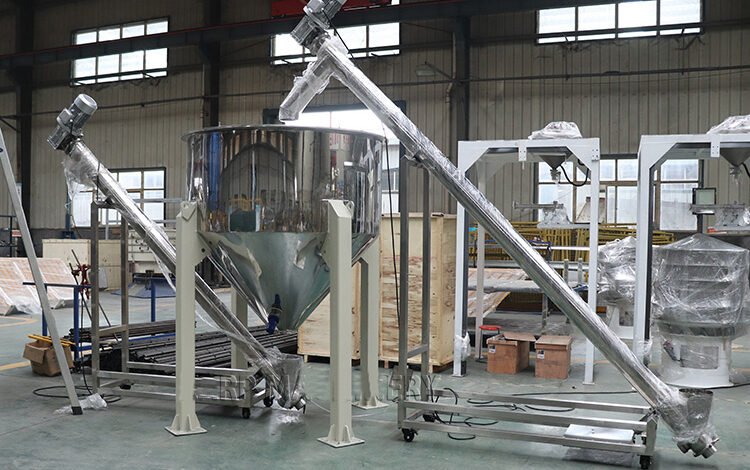
Your product flows from the hopper to the weigh bucket. Sometimes it flows fast. Sometimes slow. Your filler adjusts. It tries to compensate. But the flow variation is too wide. One bag gets 505 grams. The next gets 495 grams. Your automatic weighing filling machine cannot hit the target because the feed is not consistent. The problem is often the feed screw. A worn auger does not move the same volume per revolution as a new one. A screw with the wrong pitch creates surging. A screw that is too small requires high speed. High speed creates inertia. Product keeps moving after the screw stops. Overfill. Ask your supplier about feed screw design for your specific product. Not a generic screw. A screw designed for your bulk density, your particle size, and your flow characteristics. The screw is not a commodity. It is a precision component. Treat it that way.
The Flood Feeding That Overwhelms Your Weigh Bucket
Your feed screw runs at full speed. Product pours into the weigh bucket. The bucket reaches target weight. The screw stops. But product is already in the air. Falling. It lands in the bucket after the screw stops. Overfill. Your automatic weighing filling machine cannot stop mid-air product. The solution is two-speed feeding. High speed for the first ninety percent of the target. Low speed for the final ten percent. The low speed reduces the in-air product volume. The overfill becomes predictable. The filler compensates. Ask your supplier about two-speed or variable speed feed control. If their machine runs at one speed until target, your overfill will vary wildly. Every bag will be different. Two-speed feeding is not optional. It is essential for accurate filling. Demand it.
The Material Bridge That Collapses Without Warning
Your product looks fine. It flows. Then it stops. A bridge has formed above the feed screw. Product sticks together. It creates an arch. The screw spins. No product falls. The weigh bucket sees no weight gain. Your automatic weighing filling machine keeps the screw running. Then the bridge collapses. A flood of product dumps into the weigh bucket. Overfill. The machine alarms. You clear the bridge. Five minutes later, it forms again. The problem is hopper design. A steep-walled hopper with a mass-flow pattern does not bridge. A shallow hopper with funnel flow does. Ask your supplier about hopper angle and wall finish. If your product bridges, you need a hopper with a 70-degree slope and a polished stainless or polymer liner. Or a hopper with a mechanical agitator that breaks bridges before they collapse. Bridging is not random. It is a design failure. Fix the hopper. Your flow will become consistent.
The Flooded Screw Inlet That Compresses Your Product
Your feed screw inlet is full. Product packs into the screw flights. The screw compresses the product. The density changes. Your automatic weighing filling machine measures volume and converts to weight. But the density is not constant. Compressed product weighs more per revolution than loose product. Your fill weight drifts. The problem is screw flooding. The screw should never be completely full. There should be a small gap above the screw. Product feeds by gravity. It does not pack. Ask your supplier about screw inlet design. If the screw is fully flooded, your density will vary. Your weight will vary. An agitated hopper or a starve-fed screw prevents flooding. Your product enters the screw loosely. Density stays constant. Fill weight stays constant.
The Screw Speed That Creates A Centrifuge
Your feed screw spins too fast. Product hits the screw flight. It is thrown outward. It does not move forward. It spins in place. Your automatic weighing filling machine sees no product flow. It increases screw speed. The problem gets worse. The screw has become a centrifuge. The solution is slower screw speed with a larger diameter screw. A big screw turning slowly moves more product than a small screw turning fast. The product stays in the screw flights. It moves forward. It does not centrifuge. Ask your supplier about screw diameter and speed range. If their screw must spin at high speed to achieve your required feed rate, the screw is too small. Specify a larger screw. Your product will move forward instead of spinning in place. Your fill speed will increase. Your accuracy will improve.
The One Adjustment That Fixes Most Feed Problems
Look at the transition between your hopper and your feed screw. Is it smooth? Or is there a step, a ledge, or a gap? A step catches product. Product builds up. It hardens. It falls into the screw later. Your automatic weighing filling machine sees that hardened lump as a surge. It overfills. The fix is a smooth, continuous transition. The hopper outlet matches the screw inlet exactly. No ledges. No gaps. No steps. Ask your supplier to show you this transition on their machine. If you see any surface where product can accumulate, that surface will accumulate product. That accumulated product will release unpredictably. Your fill weights will be unpredictable. A smooth transition is simple. It is also rare. Many machines have ledges because they are easier to manufacture. Your accuracy does not care about manufacturing ease. Demand a smooth transition. Your feed will become consistent. Your fill weights will become stable. Your operators will stop chasing overfills and underfills. That is the sign of a well-designed automatic weighing filling machine. The feed is boring. Boring is good. Boring means accurate.