Retail businesses are rapidly adopting automation to improve customer experience, streamline operations, and reduce repetitive workloads. One of the most noticeable changes in modern commercial spaces is the growing use of retail service robots.
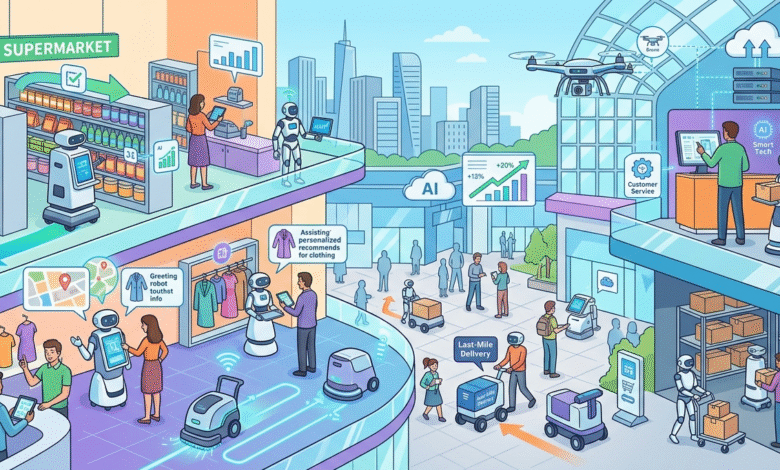
From shopping malls and supermarkets to hotels and commercial buildings, robots are now assisting customers, managing inventory, delivering products, and supporting operational tasks in ways that were once considered futuristic.
However, as retail robotics continues to expand, businesses are learning that automation alone is not always enough. Real-world commercial environments are dynamic, crowded, and constantly changing, requiring a balance between autonomous technology and human oversight.
This is why many organizations are integrating robot teleoperation and robot monitoring services into their retail automation strategies.
🤖 Why Retail Businesses Are Adopting Service Robots
Retail service robots help businesses improve operational efficiency while enhancing customer interaction. These robots can automate repetitive tasks, assist employees, and provide support during busy operational periods.
Common uses of retail robots include:
- Customer guidance and assistance
- Inventory monitoring and stock checking
- Product delivery within stores or malls
- Cleaning and sanitation tasks
- Security and surveillance support
By automating routine responsibilities, businesses can improve productivity while allowing employees to focus on customer engagement and higher-value tasks.
🏢 Challenges of Retail Robotics in Real-World Environments
Although autonomous robots offer many advantages, retail environments are highly unpredictable. Robots must operate safely around customers, employees, and constantly changing layouts.
Some common operational challenges include:
- Navigating crowded shopping areas
- Avoiding unexpected obstacles
- Responding to customer interactions
- Adapting to changing store layouts
- Managing operational interruptions
Without human oversight, these situations can reduce efficiency and negatively affect customer experience.
This is where remote monitoring and teleoperation become essential.
⚙️ The Role of Robot Teleoperation in Retail Spaces
Robot teleoperation allows trained operators to remotely monitor and assist robots in real time. Through centralized monitoring systems, operators can supervise robotic activity using camera feeds, sensors, and operational dashboards.
This human-in-the-loop approach helps businesses:
- Improve robot reliability
- Reduce operational downtime
- Maintain safe customer interactions
- Resolve navigation issues quickly
- Scale robotics deployments more efficiently
Instead of replacing automation, human operators enhance robotic performance by providing support whenever autonomous systems encounter challenges.
Businesses looking to scale automation while maintaining operational reliability often explore broader support solutions available through the OBI Services homepage.
📊 Benefits of Retail Service Robots for Businesses
Retail robots offer several advantages that support long-term business growth and operational efficiency.
✅ Improved Customer Experience
Robots can guide customers, answer basic questions, and provide assistance in large commercial spaces.
✅ Better Operational Efficiency
Automated inventory checks and routine tasks reduce manual workload for staff.
✅ Reduced Labor Pressure
Robots help businesses manage repetitive operational tasks during peak hours.
✅ Enhanced Data Collection
Retail robots gather valuable operational and customer interaction data that businesses can use for future improvements.
✅ Scalable Automation
With centralized monitoring, businesses can deploy larger robot fleets across multiple locations more effectively.
🌐 Industries Expanding Retail Robotics
Retail service robots are no longer limited to shopping malls or grocery stores. Many industries are now adopting customer-facing robotic systems.
Hospitality
Hotels use robots for guest assistance, room service delivery, and cleaning support.
Airports & Transportation Hubs
Robots assist travelers with navigation, information, and customer service.
Healthcare Facilities
Hospitals use service robots for deliveries, guidance, and operational support.
Commercial Offices
Office buildings integrate robots for visitor assistance and facility management tasks.
In each industry, combining automation with human oversight improves efficiency and reliability.
For more insights into robotics, automation, and outsourcing solutions, businesses can explore this related industry blog.
🚀 The Future of Retail Robotics
The future of retail automation is not about removing human involvement completely—it is about creating smarter collaboration between robots and people.
As robotics technology continues to improve, businesses that integrate human-in-the-loop support systems will be better positioned to:
- Scale operations more efficiently
- Improve customer experience
- Reduce operational risks
- Maintain service consistency
- Adapt to changing commercial environments
Retail service robots will continue playing a major role in modern commercial spaces, but their long-term success will depend on the ability to combine AI-powered automation with real-time human expertise.