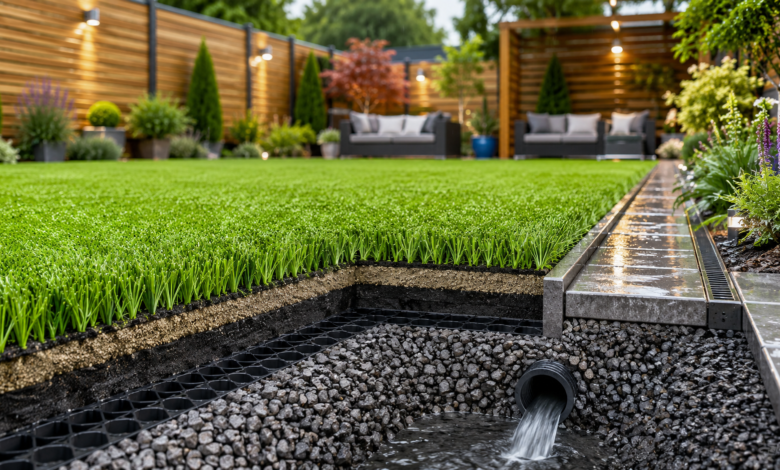
Artificial grass can keep a garden green throughout the year, but its performance depends on more than the turf itself.
Without proper artificial grass drainage, rainwater may collect on the surface, weaken the base, cause unpleasant smells, or create sunken areas. These problems are especially common in UK gardens with clay soil, compacted ground, poor runoff, or frequent heavy rain.
Planning drainage before installation helps water pass through the turf, move into the sub-base, and leave the lawn safely. This guide explains how to assess your garden, choose suitable materials, prevent waterlogging, and create a system that works in typical UK weather.
Why Artificial Grass Drainage Matters
Most artificial grass contains drainage holes in its backing, while some products use a fully permeable backing. These features allow rainwater to pass through the surface.
However, water must also move through the layers underneath. If artificial grass is laid over compacted clay, soft soil, or an uneven base, it can still collect.
Poor drainage may lead to puddles, moss, algae, slippery areas, bad smells, or movement in the sub-base. A properly planned artificial lawn drainage system keeps the surface stable and usable throughout the year.
Check Existing Drainage Before Installation
Inspect the garden during or shortly after rainfall. Look for low points, muddy sections, blocked drains, compacted soil, and water flowing from patios, paths, roofs, or neighbouring areas.
If water regularly sits in one part of the garden, artificial grass will not remove the cause. The ground beneath it must be improved first.
Identify where excess water can go. A suitable route might lead towards a permeable flower bed, channel drain, soakaway, French drain, or lower section of the garden. Never direct water towards the house, shed, or a neighbouring property.
Homeowners installing artificial grass in Warrington should make sure existing drainage problems are assessed before the turf is fitted.
Test the Soil Type
Soil type has a major effect on artificial grass drainage in UK gardens.
Sandy and gravelly soils usually drain quickly. Loam can also perform well unless heavily compacted. Clay soil holds water for longer and often needs more preparation.
Dig a small hole, fill it with water, and observe how quickly the level drops. If the water remains for a long time, the garden may need a deeper free-draining base or an additional drainage system.
Clay-heavy gardens are common across the UK. In these areas, drainage holes in the turf alone are rarely enough.
Choose Artificial Grass with Suitable Drainage
Not all artificial grass products drain at the same rate. Some have regularly spaced perforations, while others use a highly permeable backing.
For an average garden with good soil conditions, perforated backing may be suitable. Gardens used by dogs, exposed to heavy rain, or built over slow-draining ground may benefit from a more permeable product.
Compare the backing, drainage performance, density, durability, and intended use. Choosing reliable turf can reduce future drainage problems.
Excavate the Ground Correctly
Correct excavation creates space for the layers that support the lawn and manage rainwater.
The required depth depends on the soil, expected foot traffic, and existing drainage conditions. Remove old turf, roots, stones, soft topsoil, and organic material. If these remain beneath the lawn, they may decay or shift, causing dips.
The exposed ground should be firm and shaped to support the planned slope. Avoid leaving pockets where water could collect beneath the artificial grass.
Build a Free-Draining Sub-Base
The sub-base provides stability while allowing water to filter away.
Common materials include crushed granite, limestone, and other suitable granular aggregates. The right choice depends on the soil and intended use.
Gardens with reasonable natural drainage may only need a standard compacted aggregate base. Clay soil, high-traffic areas, and sites with existing waterlogging may require a deeper or more open base.
Spread the material evenly and compact it in layers. The finished base should be firm, even, and permeable. A finishing layer of granite dust can create a smooth surface for the turf.
Create a Gentle Slope
A completely flat lawn may look neat, but a slight gradient often improves artificial grass drainage.
The fall should guide water towards a safe outlet, such as a permeable border, soakaway, channel drain, or lower area of the garden. It does not need to be visually obvious.
Create the slope during excavation and sub-base preparation. In gardens surrounded by paving or raised edging, make sure the lawn does not become a shallow basin during heavy rain.
Use a Permeable Weed Membrane
A weed membrane can reduce unwanted growth beneath artificial grass, but it must allow water to pass through.
Do not use waterproof plastic sheeting, as it can trap moisture and block drainage. A suitable geotextile membrane controls weeds without stopping water from reaching the base.
Lay it flat and secure it properly. Folds or raised sections can affect the finished level and create areas where water collects.
Plan Edging Without Trapping Water
Edging keeps artificial grass secure and creates a neat finish. Timber, metal, composite, concrete, and plastic edging can all work, but the system must not block the drainage route.
If water needs to move towards a border, that edge may require drainage gaps, a permeable transition, or a nearby channel drain.
Check the lawn level against patios, paths, walls, and flower beds. Artificial grass should not sit below sealed surfaces if this causes runoff to flow onto it.
Add Extra Drainage in Problem Gardens
Some UK gardens need more than a permeable sub-base.
A French drain uses a gravel-filled trench, often with a perforated pipe, to collect and redirect water. Land drains can be installed below the base to remove moisture from clay-heavy ground. A soakaway stores excess rainwater and allows it to disperse gradually into suitable soil.
Channel drains are useful beside patios, walls, driveways, and other hard surfaces. They collect runoff before it reaches the artificial lawn.
Any additional system must have a suitable outlet. A pipe or trench without a clear discharge point will not solve waterlogging.
Plan Drainage Carefully on Concrete
Artificial grass can be installed on concrete, but water cannot drain directly into the soil.
Check whether the concrete slopes towards a drain or open edge. If water pools before installation, it is likely to remain after the turf is added.
Possible solutions include drainage holes, drainage mats, raised cells, or a route towards an existing channel. Apply adhesive carefully so it does not block water paths.
Balconies and roof terraces require particular attention because water must reach a proper outlet without collecting against walls or doors.
Avoid Common Artificial Grass Drainage Mistakes
Many drainage problems result from poor groundwork rather than the turf itself.
Common mistakes include laying artificial grass directly over existing lawn, ignoring clay soil, leaving dips in the base, using unsuitable aggregates, blocking drainage holes with adhesive, and sealing every edge.
You must plan not only how water enters the turf, but also where it goes after passing through the backing.
Maintain Drainage After Installation
Regular artificial grass maintenance helps prevent debris from blocking the turf, drainage channels, and surrounding outlets.
Remove leaves, soil, and garden debris before they build up between the fibres. Brush the lawn regularly, particularly in shaded areas or beneath trees. Pet areas should be rinsed and cleaned to reduce odours.
Check drainage outlets, channels, and lawn edges after heavy rain. If water starts collecting in a new area, investigate early. Moss or algae may indicate debris buildup, excessive shade, or slow drainage beneath the surface.
Final Thoughts
Planning artificial grass drainage for UK gardens starts with understanding the site. Check the soil, observe existing water movement, choose permeable turf, install a suitable sub-base, and create a gentle slope towards a safe outlet.
In well-draining gardens, careful groundwork may be enough. In clay-heavy or waterlogged areas, a French drain, soakaway, land drain, or channel drainage may be necessary.
Getting the drainage right before installation helps prevent puddles, odours, uneven surfaces, and expensive repairs. With the correct preparation, artificial grass can remain clean, stable, and usable through wet winters and summer downpours.