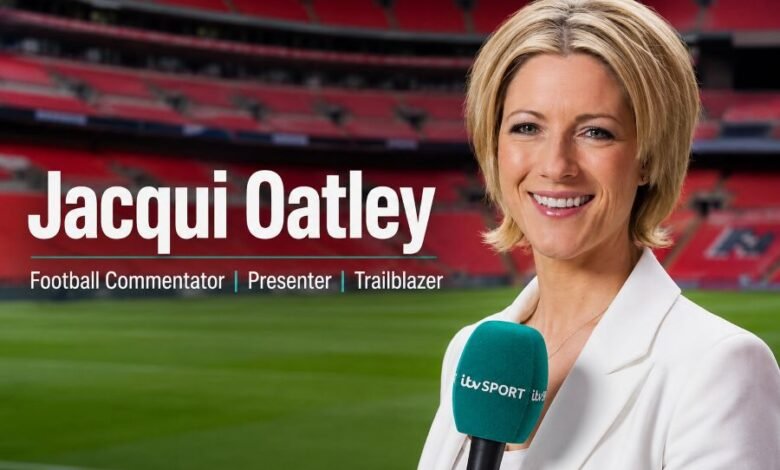
Jacqui Oatley: The Broadcaster Who Changed Who Gets Heard in Football
From non-league radio grounds to Match of the Day and World Cup commentary booths, Jacqui Oatley's career traces a major change in football broadcasting — while showing why equality in the industry remains unfinished work.

Introduction
Jacqui Oatley’s place in football history is often reduced to a single date: 21 April 2007, when she became the first female commentator on BBC One’s Match of the Day. It was a genuine breakthrough, but focusing only on that moment misses much of what makes her career significant.
Oatley had already become the first woman to call a football match on British network radio. She had worked through non-league football, local broadcasting and BBC Radio 5 Live. Years later, she crossed another barrier in the United States when she became the first woman to provide play-by-play commentary on a men’s FIFA World Cup match for a U.S. television network.
By 2026, she was still working at the highest level, commentating for FOX at another men’s World Cup.
That longevity matters. Oatley was not simply given one historic assignment and remembered for it afterward. She built a sustained career across BBC, ITV, Sky, FOX and U.S. women’s football coverage while also helping establish Women in Football, an organisation created to support women working across the sport.
Her story therefore says something larger about football media. Opportunities for women have expanded dramatically since her early career, yet recent industry research shows that discrimination and unequal treatment remain common. Oatley’s career belongs to both sides of that story: measurable progress and unfinished change.
Quick Facts About Jacqui Oatley
| Fact | Detail |
|---|---|
| Profession | Football commentator, presenter and sports journalist |
| Education | German degree, University of Leeds, 1996 |
| Journalism training | Postgraduate Diploma in Broadcast Journalism, Sheffield Hallam University |
| Early broadcasting work | Hospital radio, BBC Radio Leeds and non-league football reporting |
| Major radio first | First woman to call a football match on British network radio, 2005 |
| Match of the Day milestone | First female commentator on the programme, 21 April 2007 |
| Historic match | Fulham vs Blackburn Rovers |
| Women in Football | Co-founder in 2007; later became an ambassador |
| Honour | Appointed MBE in the 2016 New Year Honours |
| U.S. World Cup milestone | First woman to call a men’s FIFA World Cup match for a U.S. television network, 2022 |
| Recent international work | Women’s Euro 2025 and men’s FIFA World Cup 2026 for FOX |
| Former ITV role | Presented football and darts; her ITV Sport run ended in 2025 |
Football Was Part of Her Life Before Broadcasting
Oatley’s route into sports journalism was far from conventional.
She studied German at the University of Leeds, graduating in 1996, and played football while at university. After graduating, she did not immediately pursue television or radio. She worked in intellectual property and continued playing football outside her professional life.
A serious knee injury changed that direction.
Later accounts from Oatley describe the injury as an important point in the transition from playing football toward covering it. Rather than immediately entering a major broadcaster, however, she started at a much more basic level. She gained experience through hospital radio and journalism training before deciding to make broadcasting her career.
That decision involved considerable professional risk. Oatley left an established career path and retrained in journalism, eventually completing a postgraduate qualification in broadcast journalism at Sheffield Hallam University, where she is listed among the institution’s notable alumni from the class of 2003.
The sequence matters because it challenges a misleading version of her career in which she suddenly appeared on national television as a symbolic appointment. Her high-profile breakthrough came only after years of retraining and lower-level reporting.
Non-League Football Was Her Real Apprenticeship
Before millions of television viewers heard Oatley’s voice, much of her work involved grounds far removed from the Premier League.
She began covering football for BBC Radio Leeds, including non-league matches. Associated Press reporting identifies Wakefield & Emley against Worksop Town as her first commentary assignment in 2003.
These early games gave her the practical experience required of any football commentator: following play accurately, identifying players quickly, describing action clearly and working in broadcasting conditions that were often basic.
Oatley has recalled learning the profession at grounds where sightlines and press facilities could be difficult. That experience makes an important point about her later achievements.
The controversy surrounding her gender sometimes obscured the ordinary professional development underneath it. She had learned the work in much the same way many commentators do — covering smaller matches before progressing toward national broadcasting.
Her rise therefore combined two separate stories. She was developing as a journalist, but she was also entering positions that women had historically been excluded from.
Those stories collided in 2005.
The 2005 Radio Milestone Came Before Match of the Day
Oatley’s first major broadcasting breakthrough did not occur on television.
According to FOX Sports and Women in Football, she became the first woman to call a football match on British network radio in 2005, during the period of the Women’s European Championship.
The wording is important.
Oatley is sometimes described online simply as Britain’s “first female football commentator.” That claim is too broad to use responsibly. The evidence supports several precise firsts, and those are impressive without exaggeration.
The 2005 achievement concerned British network radio.
Two years later came the milestone for which she remains best known.
21 April 2007 Changed Match of the Day
On 21 April 2007, Oatley commentated on Fulham against Blackburn Rovers for BBC One’s Match of the Day.
BBC records confirm that the assignment made her the first female commentator in the programme’s history.
For a programme that had been central to British football television for decades, the significance was obvious. Yet the reaction quickly extended beyond Oatley’s actual performance.
Her appointment became a media story in itself.
Discussions emerged over whether a woman should commentate on men’s football, a debate that revealed how strongly some broadcasting roles were still associated with men. Oatley later recalled the discomfort of suddenly becoming the subject of attention when her journalistic training had taught her that the reporter or commentator should focus attention on the event.
That distinction helps explain why the 2007 assignment remains important.
The historic element was not that women lacked the technical ability to describe football. It was that British football television had reached a point where one woman’s presence in a commentary role could generate national debate.
The controversy revealed the barrier as clearly as the appointment broke it.
She Became More Than a Historic One-Off
Being remembered for a “first” can sometimes obscure what happens afterward. Oatley’s career did not stop at the 2007 breakthrough.
She continued working across football broadcasting, including major international competitions. Her assignments included work around the 2010 men’s World Cup for BBC Radio 5 Live, the BBC’s coverage of the 2015 Women’s World Cup, ITV’s coverage of the 2018 men’s World Cup, and commentary on the world feed during the 2019 Women’s World Cup.
She also moved between commentary and presenting.
In March 2015, she presented Match of the Day, another significant step because presenting the programme was a different responsibility from providing match commentary.
That same year, ITV announced that Oatley was joining as a sports presenter. Her work there included football and Professional Darts Corporation coverage.
The length of that ITV relationship is notable. She presented darts for more than a decade before her ITV Sport run ended with the 2025 Players Championship Finals. This matters because older online profiles still sometimes describe her as a current ITV darts presenter. By 2026, that information was outdated.
Her career had already moved further into international football broadcasting.
Women in Football Turned Representation Into Organised Action
Oatley’s contribution to football cannot be measured only by broadcasting assignments.
In 2007, the same year as her historic Match of the Day commentary, she became one of the co-founders of Women in Football, alongside journalist Anna Kessel and football executive Shelley Alexander.
The organisation developed into a network supporting women across different parts of the football industry, not simply those working as presenters or journalists.
That makes Oatley’s involvement particularly significant. She did not merely become a visible example of a woman succeeding inside football media. She was involved in building an organisation intended to address the broader workplace problems women were experiencing.
She served as a director before moving into an ambassador role in 2017.
Her association has continued. Women in Football records Oatley remaining involved in public discussions and events, including moderating industry conversations in 2026.
The organisation’s more recent research also provides context for why this work remains relevant.
The Industry Has Changed, but the Numbers Show Persistent Problems
There are far more female voices in football media today than when Oatley made her Match of the Day debut. That change is visible.
It should not, however, be confused with the disappearance of workplace inequality.
Women in Football’s 2025 workforce survey included 867 respondents: 759 women, 100 men and eight non-binary participants.
Among female respondents, 78% said they had experienced gender discrimination at work. About 63.5% reported sexist jokes or banter, while more than half said no action had been taken after they reported gender-based discrimination.
Another 86% of female respondents said women have to work harder than men to receive the same recognition and benefits. Interestingly, 69% of male respondents agreed.
Those figures require careful interpretation. The survey was not a random sample of every person working in football, so it cannot establish that exactly 78% of all women across the industry experience discrimination.
It does, however, provide substantial evidence that discriminatory behaviour remains a serious concern among women participating in the football workforce.
This context changes how Oatley’s legacy should be understood.
Her breakthrough was meaningful, but it did not solve the underlying problem. Representation increased faster than some workplace attitudes changed.
An MBE Recognised Broadcasting and Diversity Work
Oatley’s contribution received formal recognition through the 2016 New Year Honours, when she was appointed a Member of the Order of the British Empire, or MBE.
The official honours record cited her services to broadcasting and diversity in sport.
Some profiles list the honour as occurring in 2015. The confusion comes from timing: the 2016 New Year Honours were announced in late December 2015.
The formal designation is therefore an MBE in the 2016 New Year Honours.
That wording matters because it reflects both elements of her career. The award did not recognise broadcasting alone; it also acknowledged her work connected with diversity in sport.
Sky and the Growth of Women’s Football Broadcasting
Another major phase came in 2021, when Sky Sports announced Oatley as part of its commentary team for the Women’s Super League.
By then, women’s football broadcasting was operating in a very different environment from the one in which Oatley had started.
Major women’s competitions had gained stronger television distribution, investment and audiences. Female commentators were no longer treated as unprecedented in quite the same way.
But there remained another frontier for Oatley’s career: American network television at a men’s World Cup.
Qatar 2022 Created Another Broadcasting First
On 22 November 2022, Oatley called Denmark against Tunisia at the FIFA World Cup in Qatar for FOX Sports, working alongside Warren Barton.
FOX described the assignment as historic: Oatley became the first woman to provide play-by-play commentary on a men’s FIFA World Cup match for a U.S. television network.
Again, precision matters.
Some sources have described the achievement more broadly as the first time a woman commentated on football for a U.S. network. FOX’s narrower description is better supported and should be preferred.
What makes the 2022 milestone particularly striking is its timing.
Fifteen years had passed since her Match of the Day debut. Oatley was still breaking firsts, but now in another broadcasting market and at the world’s largest men’s football tournament.
It showed that her career had become international rather than simply British.
Women’s Euro 2025 Showed How Much the Audience Had Changed
The evolution of football broadcasting becomes especially clear when Oatley’s 2007 experience is compared with her work at Women’s Euro 2025.
She called the final between England and Spain for FOX.
The U.S. English-language broadcast averaged about 1.35 million viewers and reportedly peaked at 1.92 million. Across the tournament, FOX’s English-language coverage averaged roughly 458,000 viewers per match, almost double the comparable figure from the previous European Championship.
The audience figures do not prove that women’s football has reached equality with men’s coverage. Research from Women in Sport still indicates that women’s sport occupies a relatively small share of overall sports media coverage.
But the comparison is revealing.
In 2007, the presence of one woman commentating on men’s highlights was itself treated as a major story. By 2025, Oatley was calling the final of a major women’s international tournament for an American audience exceeding one million viewers.
Football’s media environment had changed around her.
World Cup 2026 Confirmed Her Place at the Top Level
Oatley’s career remained active into 2026.
FOX selected her for its men’s FIFA World Cup coverage and once again paired her with Warren Barton. The network described the tournament as her fifth major international competition with FOX.
Her assignments included matches from the group stage, demonstrating that the 2022 World Cup milestone was not a ceremonial one-off. She had become an established member of the network’s major-tournament commentary operation.
One unusual moment occurred during Colombia against Uzbekistan in Mexico City, when Barton was struck by an object thrown from the crowd while working alongside Oatley. The broadcast continued as she addressed what had happened.
The incident itself is secondary to Oatley’s career story. What matters more is the setting: almost two decades after becoming a controversial first on Match of the Day, she was still working live from football’s largest tournament.
Why Calling Oatley Simply a “Pioneer” Is Not Enough
“Pioneer” is accurate, but incomplete.
The word can make Oatley’s career sound as though its importance lies only in arriving before other women. Her record shows something more complicated.
She had to establish professional credibility through ordinary journalism work while operating in an environment where her gender attracted extraordinary attention.
She then continued long enough for some of the roles she once entered as a first to become less unusual.
BBC reporting has documented women such as Vicki Sparks and Robyn Cowen subsequently commentating on Match of the Day. That does not mean Oatley alone caused those opportunities. No credible evidence allows such a direct causal claim.
It does show that the landscape in which she works has changed.
The distinction matters. Oatley’s strongest legacy claim is not that every female broadcaster who followed did so because of her. It is that she provided one highly visible precedent proving that a role which had traditionally been occupied by men could be performed by a woman at the highest level.
Her Career Also Reflects the Rise of Women’s Football Itself
Another part of Oatley’s career can easily be overlooked.
She has covered both men’s and women’s football throughout a period when the commercial and cultural position of the women’s game changed sharply.
Women in Sport has reported that women’s sport still represented only around 8% of sports coverage on key channels in 2024, illustrating the size of the remaining visibility gap.
At the same time, events such as Women’s Euro 2025 have shown that women’s football can generate substantial international television audiences.
Oatley’s career therefore sits at an unusual intersection.
She helped challenge assumptions about who could describe football, while the sport itself was simultaneously challenging assumptions about which football audiences would watch.
Those are separate developments, but they reinforce each other.
More women’s football creates more broadcasting opportunities. Greater diversity within football media broadens the pool of voices explaining and interpreting the game. Neither process automatically guarantees equality, but both have changed what audiences now consider normal.
Jacqui Oatley’s Legacy Is Still Being Written
It would be easy to frame Jacqui Oatley’s career as a completed story of barriers falling away.
The evidence suggests something more nuanced.
The barriers she encountered were real. The 2007 reaction to her Match of the Day commentary demonstrated how unusual some audiences considered a female voice in men’s football broadcasting. Her later career shows substantial progress: major BBC assignments, ITV presenting, Sky coverage, World Cups, Women’s Euros, NWSL broadcasting and repeated work for FOX.
Yet current evidence from Women in Football shows that many women inside the industry still report discrimination, sexist behaviour and unequal access to recognition or career development.
That does not diminish Oatley’s achievements. It explains why they remain relevant.
Her most important contribution may be the distance between what once caused controversy and what now looks increasingly ordinary. A woman commentating on elite football no longer automatically becomes the national story simply because she is there.
Oatley helped make that change visible.
And unlike many careers defined by a historic first, hers did not stop after the barrier was crossed. Nearly two decades after Fulham against Blackburn put her at the centre of a national debate, she was still describing World Cup football from the commentary booth.
Frequently Asked Questions
Why is Jacqui Oatley famous?
Jacqui Oatley is best known for becoming the first female commentator on BBC One’s Match of the Day on 21 April 2007. She has also worked across BBC, ITV, Sky and FOX and has commentated at major international football tournaments.
What match did Jacqui Oatley first commentate on for Match of the Day?
Her historic Match of the Day commentary was Fulham vs Blackburn Rovers on 21 April 2007.
Was Jacqui Oatley the first female football commentator?
That description is too broad. She was the first woman to call a football match on British network radio in 2005 and the first female commentator on Match of the Day in 2007. In 2022, she also became the first woman to call a men’s FIFA World Cup match for a U.S. television network.
What did Jacqui Oatley study?
She studied German at the University of Leeds, graduating in 1996. She later completed postgraduate training in broadcast journalism at Sheffield Hallam University.
What is Jacqui Oatley’s connection to Women in Football?
Oatley was one of the co-founders of Women in Football in 2007, alongside Anna Kessel and Shelley Alexander. She later moved from a director role to becoming an ambassador.
Why did Jacqui Oatley receive an MBE?
She was appointed MBE in the 2016 New Year Honours for services to broadcasting and diversity in sport.
Does Jacqui Oatley still present ITV darts?
No. Her long-running ITV Sport role ended in 2025. Older profiles that still describe her as ITV’s current darts presenter are outdated.
What was Jacqui Oatley’s World Cup first?
During the 2022 FIFA World Cup, she became the first woman to provide play-by-play commentary on a men’s World Cup match for a U.S. television network when she called Denmark vs Tunisia for FOX.
What is Jacqui Oatley doing in 2026?
Her documented 2026 work includes football commentary in the United States and coverage of the 2026 FIFA World Cup for FOX Sports, where she again worked alongside Warren Barton.