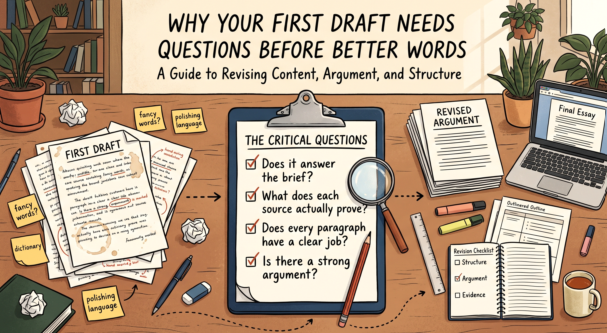
You finish an essay, run a spellcheck and replace a few ordinary words with more formal ones. The draft sounds smoother. Yet the main concern remains: does it actually answer the question?
That uncertainty calls for a different kind of review. Before polishing sentences, check what your argument claims, how your evidence supports it and why each paragraph belongs. These questions give revision a purpose and help you avoid spending an evening perfecting a section you later need to cut.
Start with the question your essay must answer
Put the assignment brief beside your draft. Underline the instruction that defines the task: compare, evaluate, explain or critically discuss. Then write a one-sentence answer in plain English.
For example, a question asking you to evaluate online learning needs a judgement about its strengths, limitations and conditions. A list of platform features will not fully answer it. Your introduction should establish the position you will develop, while the body should supply the reasoning behind that position.
Now compare your one-sentence answer with the conclusion. If they point in different directions, decide whether your argument changed during writing or whether the draft has wandered away from the brief.
Give every paragraph a clear job
Write a short label beside each paragraph: defines the issue, presents evidence, examines a limitation, compares an alternative or explains an implication. This creates a reverse outline of the essay you have actually written.
Look for places where several paragraphs perform the same job. You may have repeated the background three times while leaving the counterargument unexplored. Moving or combining those paragraphs can improve the structure without adding more words.
When working from lecture recordings or interview transcripts, separate the source material from your interpretation. Choose notes that support the paragraph’s purpose and retain the details you need to reference them accurately.
Ask what each source actually proves
A citation tells readers where information came from. Your explanation must show what that information contributes to the argument.
Consider this illustrative sentence: “Students said that recorded lectures were convenient, so online learning improves academic performance.” The conclusion goes further than the evidence. Convenience and academic performance are different outcomes.
A more careful interpretation would explain that the finding supports a claim about flexibility. Evidence about learning outcomes would still be needed before making a claim about performance. This kind of revision makes the reasoning more precise without relying on complicated vocabulary.
For each important source, ask:
- What outcome or issue did it examine?
- Does its population or setting match the claim I am making?
- What limitation affects how confidently I can use it?
Read the original source before answering. A title, abstract or second-hand summary may leave out a qualification that matters to your paragraph.
Turn a general worry into a specific revision task
“My analysis is weak” is difficult to act on. “This paragraph reports two findings but does not explain why they differ” gives you something concrete to revise.
If you want a structured starting point, Marker’s Eye reviews your own draft against areas such as argument, evidence, structure and relevance. Providing the brief and marking rubric helps put the feedback in context. Treat the report as material to assess against your actual work and lecturer’s instructions.
Choose a small number of priorities from the feedback. An unanswered part of the question should come before repetitive wording. A claim without support should come before a slightly awkward transition.
Record the problem you identified and the change you made. When you review the next draft, check whether that change resolved the issue or whether the paragraph still needs attention.
Revise the reasoning before polishing the language
Work through the draft in separate passes. First, check that it answers the task. Next, inspect the argument and sources. Then review paragraph order. Leave sentence editing and presentation until those decisions are settled.
Suppose two sections make the same point using different examples. Decide whether both examples are necessary. If one adds little, remove it and use the space to explain a limitation or competing interpretation. Shortening the draft can create room for deeper analysis.
When you reach the language pass, prefer wording you understand and can defend. Replace vague phrases with precise statements, clarify who or what a sentence refers to, and break up sentences that contain several separate claims.
Choose support that matches your stage
The help you need before writing may differ from the help you need after a first draft or after tutor feedback. My Perfect Writing provides tools for these stages, helping students interpret briefs, review their own drafts and understand feedback. Start with the task you need to complete, then choose the relevant support.
Keep a short revision record: what you changed, why you changed it and what still needs checking. Follow your university’s rules on external and AI-assisted support, and make sure you can explain the reasoning in the final submission.
Common questions about reviewing a first draft
What should I check first
Check the assignment question and marking criteria. Identify any requirement the draft has missed before spending time on grammar or formatting.
How can I tell whether a paragraph is too descriptive
Ask whether it only reports information. Analysis explains the information’s significance, evaluates its limitations or uses it to support a reasoned judgement.
Will a feedback tool predict my final mark
Treat any indicative grade or assessment as guidance. Your lecturer applies the actual criteria, and a tool cannot guarantee the outcome.
Make the next revision count
Before changing another adjective, identify one claim that needs support, one paragraph that needs a clearer purpose and one missing answer to the brief. Resolving those issues gives your final language edit a stronger draft to work with.