For many men and women in Britain, the decision to look into hair restoration starts quietly: a glance at a holiday photo, a change in how a parting falls, or a comment from a hairdresser. Once the research begins, the options quickly multiply. Clinics in London and Manchester sit alongside packages in Istanbul, and social media feeds are full of confident recommendations. Planning well means slowing down, asking the right questions and building a timeline that fits around work and family life.
Starting With the Right Questions
Before comparing destinations, it helps to be clear about the problem itself. Hair loss has many causes, from genetic pattern loss to thyroid conditions, stress, iron deficiency or certain medications. A transplant only makes sense for some of them. A conversation with a GP or a dermatologist can rule out treatable causes and may lead to a referral for blood tests.
It is also worth knowing that cosmetic hair restoration is generally not funded by the NHS, so most UK patients will be paying privately wherever they go. That makes the planning stage even more important, because the choice is entirely in the patient’s hands.
Questions to answer for yourself first
- Is the hair loss stable, or is it still progressing quickly?
- Have medical options been discussed with a doctor?
- Which area bothers you most: the hairline, the crown or overall thinning?
- How much time off work can you realistically take?
- Are you comfortable travelling for a medical procedure?
Comparing UK and Turkey Options
The surgical principles are the same in both countries. Follicular units, small natural groups of one to four hairs, are taken from the donor area at the back and sides of the scalp and placed where hair has thinned. The most common methods are FUE, where grafts are extracted one by one, and DHI, where an implanter pen places each graft. What differs between the two countries is mainly the experience around the surgery.
In the UK, providers in England are expected to be registered with the Care Quality Commission, and doctors can be checked on the General Medical Council register. Consultations usually happen in person, follow-up appointments are a train ride away, and there is no flight to plan around. Prices are generally higher, which is the main reason many people start looking abroad.
In Turkey, the sector is overseen by the Ministry of Health, which licenses hospitals and authorises health-tourism intermediaries. Treatment is usually organised as a short trip, often with accommodation, transfers and interpreter support included. A detailed comparison of UK or Turkey for a hair transplant sets out these differences side by side, and it is useful reading before any consultation.
What to ask any provider, at home or abroad
- Where exactly will the procedure take place, and is the facility licensed?
- Which doctor is responsible, and which steps will that doctor perform personally?
- How many grafts are planned, and why?
- What is included in the written, itemised quote, and what costs extra?
- How is aftercare handled once you are back in the UK?
Prices vary considerably between providers and depend on the number of grafts, the technique and what is included. Comparing written quotes line by line is far more useful than comparing a headline figure.
Planning the Trip
If Turkey is the chosen route, the trip usually lasts a few days. Many patients arrive the day before surgery for blood tests and hairline planning, have the procedure the next day, and return for a check and the first wash before flying home. Direct flights from several UK airports make the journey manageable, but it is sensible to leave a little slack in the schedule rather than booking the tightest possible return.
A few practical points deserve attention. Standard travel insurance policies often exclude elective procedures abroad, so check the small print or look for specialist cover. Bring a list of any medication you take and share your full medical history in advance. Pack loose, button-up shirts that do not need to be pulled over the head, and a soft, loose-fitting hat for the journey home.
Some patients prefer to work through an organiser rather than contacting hospitals directly. One example is turkeyhaircenter.com, the website of Turkey Hair Center, a Ministry of Health authorised health-tourism intermediary that connects patients with licensed hospitals and doctors in Turkey. Whichever route you take, confirm the name of the facility and the responsible doctor before you travel.
Recovering While Working
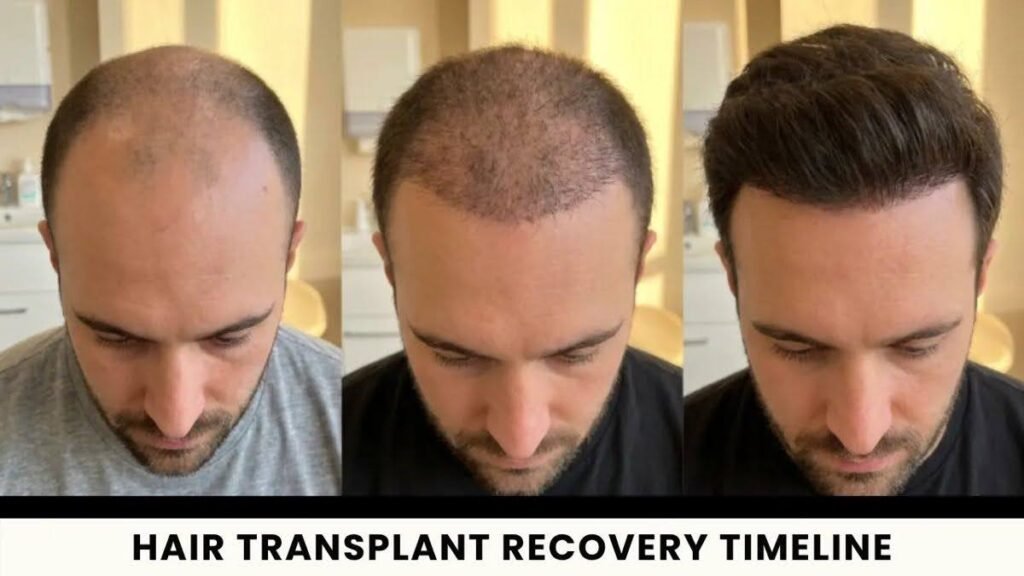
For people with desk jobs, the first week is usually the main concern. Swelling around the forehead often appears in the first few days and then settles. Small scabs form over the grafts and typically fall away within about ten days with gentle washing. Many office workers take around a week off, while those in physical or outdoor jobs may need longer because heavy lifting, sweating and direct sun are usually discouraged in the early weeks.
Remote working has made recovery easier for some. A few days of video calls with the camera at a flattering angle can bridge the gap until the scabs are gone. It is also worth preparing for the shedding phase between two and eight weeks after surgery, when many transplanted hairs fall out. This is expected, and new growth commonly starts to appear from around the third or fourth month, with the result usually judged at about twelve months.
Follow-Up With Your GP
A GP does not usually provide routine aftercare for private cosmetic surgery, but remains the first point of contact if something does not feel right. It helps to tell the practice before travelling and to bring home a written summary of the procedure, the medication prescribed and the aftercare instructions. Signs such as increasing redness, heat, discharge or fever should be checked promptly rather than waiting for a scheduled review.
Many patients also continue medical treatment for the hair they still have, since a transplant does not stop ongoing loss. That conversation belongs with a doctor who knows your history, and a GP can help coordinate it.
Conclusion
Choosing between the UK and Turkey is less about which country is better and more about which plan you can verify and live with. Check licences and doctor involvement, compare itemised quotes, build a realistic travel and work schedule, and keep your GP informed. With that groundwork, the decision becomes a considered one rather than a leap of faith