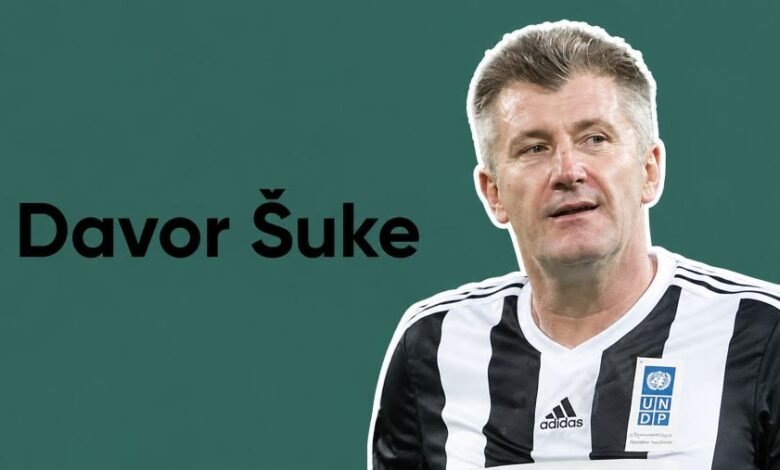
Davor Šuker: Powerful Rise of Croatia’s Golden Boot Icon
From Osijek’s football grounds to World Cup glory, discover the career, achievements and lasting influence of Croatia’s record-breaking striker.

Introduction
Davor Šuker is a Croatian former professional footballer known for his intelligent movement, calm finishing and historic performances for his country. He became a global football icon after finishing as the leading scorer at the 1998 FIFA World Cup.
His career took him from Osijek and Dinamo Zagreb to Sevilla, Real Madrid, Arsenal, West Ham United and 1860 Munich. He also became an influential football administrator after ending his playing career.
Davor Šuker is best known as Croatia’s record international goalscorer and the winner of the 1998 World Cup Golden Boot.
Quick Bio
| Field | Details |
|---|---|
| Full Name | Davor Šuker |
| Date of Birth | 1 January 1968 |
| Age | 58 years old as of 2026 |
| Birthplace | Osijek, Croatia, then part of Yugoslavia |
| Nationality | Croatian |
| Profession | Former professional footballer and football administrator |
| Playing Position | Centre-forward |
| Preferred Foot | Left |
| Height | Approximately 1.83 metres |
| Senior Career | 1984–2003 |
| Croatia Goals | 45 |
| Major Clubs | Sevilla, Real Madrid, Arsenal and West Ham United |
| Biggest Achievement | 1998 FIFA World Cup Golden Boot |
| Administrative Role | Croatian Football Federation president, 2012–2021 |
Early Life in Osijek
Šuker was born on 1 January 1968 in Osijek, a Croatian city that was then part of Yugoslavia. Sport formed an important part of his early environment, and his natural football ability became visible while he was still young.
He developed through the football system in Osijek before reaching the senior team as a teenager. Playing against older and physically stronger opponents taught him how to move intelligently, protect the ball and find space inside the penalty area.
His rise also reflected the strength of football development across the former Yugoslavia. Technical quality, close control and tactical intelligence were valued from an early stage.
Modern players connected with Croatian football talent continue to demonstrate the technical qualities that shaped Šuker’s early development.
Football Education and Early Development
Šuker’s most important education came through structured football training, competitive youth matches and senior experience with Osijek.
He did not depend only on physical strength. His game was built around timing, awareness and his ability to understand where a scoring chance was likely to appear.
His development accelerated when he represented Yugoslavia at youth level. He was part of the team that won the 1987 FIFA World Youth Championship in Chile.
Šuker scored six goals during that competition. The tournament introduced him to a wider international audience and showed that he could perform under pressure.
The development of a young Croatian defender follows a different positional path, but it reflects the same importance of academy education and early senior experience.
Career Start With Osijek
Šuker began his senior career with Osijek in 1984. He was only 16 when he entered professional football.
His early seasons allowed him to improve without the intense attention that later followed him in Spain. He gradually became one of the most dangerous young forwards in the Yugoslav league.
During the 1988–89 season, he scored 18 league goals. That successful campaign established him as an elite domestic striker and prepared him for a move to a larger club.
He left Osijek with 40 league goals from 91 appearances. These numbers showed that his scoring ability was based on consistent performance rather than one short period of form.
Dinamo Zagreb Breakthrough
Dinamo Zagreb signed Šuker in 1989. The transfer placed him at one of the biggest clubs in the region and increased expectations around his career.
He responded by scoring regularly. Across two league seasons, he recorded 34 goals in 60 appearances.
His second campaign was especially productive, with 22 goals from 32 league matches. His performances attracted interest from major European leagues.
Political instability and conflict were also affecting life and football across Yugoslavia during this period. A transfer abroad offered both a professional opportunity and a more stable football environment.
Becoming a Star at Sevilla
Šuker joined Sevilla in 1991 and began the most important development period of his club career.
Adapting to Spanish football was not immediate. La Liga demanded technical quality, fast decisions and an ability to perform against organised defences.
Once settled, he became one of the competition’s most reliable goalscorers. His intelligence inside the box allowed him to score without depending on constant possession.
His finest Sevilla league campaign came in 1993–94, when he scored 24 goals. Only Barcelona striker Romário finished above him in the scoring race.
Šuker also shared the Sevilla dressing room with Diego Maradona. Playing alongside such an influential figure added another memorable chapter to his time in Spain.
He scored 76 league goals in 153 appearances for Sevilla. His five seasons at the club turned him from a promising forward into a recognised European star.
Like other players who develop into a powerful centre-forward, he combined technical improvement with the confidence gained from regular first-team football.
Real Madrid Success
Real Madrid signed Šuker in 1996 following his impressive performances with Sevilla and Croatia.
He made an immediate impact by scoring 24 La Liga goals in his first season. His goals helped Real Madrid win the 1996–97 Spanish league title.
Šuker formed a dangerous attacking partnership with Raúl and Predrag Mijatović. Each player offered different qualities, making the forward line difficult to defend against.
His movement created space, while his left foot provided accuracy and variety around the penalty area. He could finish with power, but he was equally comfortable using a delicate chip or placed shot.
Real Madrid won the UEFA Champions League in the 1997–98 season. The victory added Europe’s biggest club trophy to his growing list of achievements.
According to Real Madrid’s official legend profile, he scored 49 goals in 109 official appearances for the club.
His Real Madrid honours included:
- La Liga in 1996–97
- Spanish Super Cup in 1997
- UEFA Champions League in 1997–98
- Intercontinental Cup in 1998
Croatia and Euro 1996
Šuker became one of the leading figures of Croatia’s newly established national team during the 1990s.
He scored heavily during qualification for UEFA Euro 1996 and entered the tournament as one of Europe’s most respected forwards.
Croatia reached the quarter-finals in its first major international tournament as an independent nation. Šuker scored three goals during the competition.
His most famous Euro 1996 moment came against Denmark. After identifying goalkeeper Peter Schmeichel’s position, he lifted the ball over him with a controlled and confident finish.
The goal represented everything that made him special: awareness, imagination, calmness and technical quality.
Historic 1998 FIFA World Cup
The 1998 World Cup in France became the defining competition of Šuker’s career.
Croatia was appearing at the World Cup for the first time as an independent nation. The team entered without the historical tournament record enjoyed by countries such as Brazil, Germany or Italy.
Šuker scored six goals in seven matches. His goals came against Jamaica, Japan, Romania, Germany, France and the Netherlands.
He scored during the semi-final against host nation France, briefly putting Croatia ahead. France recovered to win 2–1 and later became world champion.
Croatia then defeated the Netherlands in the third-place match. Šuker scored the winning goal and completed one of the greatest individual World Cup campaigns of the decade.
He received the 1998 FIFA World Cup Golden Boot after finishing as the competition’s leading scorer.
He also received the Silver Ball as the tournament’s second-best player. Croatia’s bronze medal established the country as a serious international football force.
Later Career in England and Germany
Šuker joined Arsenal in 1999 after leaving Real Madrid.
Arsenal already had strong attacking options, including Thierry Henry, Dennis Bergkamp and Nwankwo Kanu. Competition for regular playing time was therefore intense.
He still produced important moments and scored ten goals from 15 starts during his only season at the club.
Šuker appeared as a substitute in the 2000 UEFA Cup final against Galatasaray. The match ended without a goal before Galatasaray won the penalty shoot-out.
He moved to West Ham United in 2000. Injuries and limited playing opportunities prevented him from reproducing the form of his peak years in Spain.
His Premier League record across Arsenal and West Ham was 33 appearances and ten goals.
Šuker completed his professional career with 1860 Munich in Germany. He retired from football in 2003.
The different career routes taken by a modern left-footed striker show how attackers must continue adapting when moving between countries and leagues.
International Record and Major Achievements
Šuker scored 45 goals for Croatia, making him the leading goalscorer in the history of the men’s national team.
Croatian Football Federation records list him with 69 national-team appearances. Some statistical databases use 68 FIFA-recognised caps because of the status of an early Croatia match.
His major individual honours include:
- FIFA World Cup Golden Boot in 1998
- FIFA World Cup Silver Ball in 1998
- FIFA World Cup All-Star Team selection
- Second place in the 1998 Ballon d’Or voting
- Third place in the 1998 FIFA World Player of the Year voting
- UEFA Euro 1996 Team of the Tournament
- Croatia’s UEFA Jubilee Golden Player
- Selection in the FIFA 100 list
- Multiple Croatian Footballer of the Year awards
These achievements place him among the most successful forwards produced by European football during the 1990s.
Playing Style and Strengths
Šuker was a naturally gifted left-footed striker who preferred intelligent positioning over unnecessary movement.
He studied defenders and moved into spaces where the ball was likely to arrive. This made him dangerous even when he had not been heavily involved in the earlier stages of an attack.
His first touch was controlled, and he rarely appeared rushed inside the penalty area. He could score with placed finishes, first-time shots, penalties and delicate chips.
He also showed strong emotional control. Important matches did not stop him from attempting creative finishes.
His style shared qualities with the traditional classic goal-scoring forward: direct movement, confidence near goal and a strong understanding of attacking space.
Challenges and Career Turning Points
Moving from Yugoslavia to Spain during a period of regional conflict was one of the biggest changes in Šuker’s life.
He had to adapt to a new language, football culture and level of competition. His early patience at Sevilla became an important part of his eventual success.
Another turning point came after the 1998 World Cup. Although he was at the height of his international reputation, his playing opportunities at Real Madrid became more limited.
His later moves to Arsenal, West Ham and 1860 Munich did not produce the same scoring numbers as his years in Spain.
However, those difficult final seasons did not erase his earlier achievements. His record with Croatia and his influence at Sevilla and Real Madrid remained secure.
Croatian Football Federation Leadership
After retiring, Šuker became involved in youth development and football administration.
He was elected president of the Croatian Football Federation in July 2012, replacing Vlatko Marković.
During his presidency, Croatia reached the 2018 FIFA World Cup final. It was the country’s best international result and built upon the foundation created by the 1998 generation.
Šuker was also elected to the UEFA Executive Committee in 2015 and remained involved in European football governance.
His Croatian Football Federation presidency ended in July 2021 when Marijan Kustić became the new president.
Current Status
As of June 2026, Šuker is retired from professional football and no longer serves as president of the Croatian Football Federation.
He remains visible at football events, in interviews and in historical World Cup coverage. His views continue to receive attention because of his experience with Croatia, Real Madrid and international football leadership.
Recent FIFA features have revisited his 1998 performances and the emotional importance of that tournament to both him and Croatia.
His public role is now mainly connected with football heritage, international events, youth development and the promotion of the sport.
Legacy and Influence
Šuker’s legacy extends beyond his 45 international goals.
He helped give Croatian football an identity on the world stage. The 1998 team showed that a young and relatively small football nation could compete against established powers.
His Golden Boot also gave Croatian supporters an individual hero during the country’s first World Cup appearance.
Later generations, including Luka Modrić’s team, built upon the expectations created by Šuker, Zvonimir Boban, Robert Prosinečki and their teammates.
At club level, he remains remembered most strongly by Sevilla and Real Madrid supporters. His movement, left-footed finishing and ability to create memorable goals made him one of La Liga’s leading forwards of the 1990s.
Conclusion
Davor Šuker built a remarkable football career through intelligence, technical skill and calm finishing.
His journey began in Osijek, developed through Dinamo Zagreb and Sevilla, and reached the highest club level with Real Madrid. He later experienced English and German football before retiring in 2003.
The 1998 World Cup remains his greatest chapter. Six goals, a Golden Boot and a bronze medal transformed him into a national icon.
His work as Croatian Football Federation president later gave him influence away from the pitch. However, his strongest legacy will always be the goals that helped introduce Croatian football to the world.
Frequently Asked Questions
Who is Davor Šuker?
He is a retired Croatian footballer and former Croatian Football Federation president.
How old is he?
He is 58 years old as of June 2026.
When was he born?
He was born on 1 January 1968.
Where was he born?
He was born in Osijek, Croatia, when the city was part of Yugoslavia.
What position did he play?
He played as a centre-forward or striker.
How many goals did he score for Croatia?
He scored 45 international goals for Croatia.
Why is he famous?
He is famous for winning the 1998 FIFA World Cup Golden Boot after scoring six goals.
Which major clubs did he represent?
He played for Sevilla, Real Madrid, Arsenal, West Ham United and 1860 Munich.
Did he win the Champions League?
Yes. He was part of the Real Madrid team that won the 1997–98 UEFA Champions League.
When did he retire?
He retired from professional football in 2003.