Lucy Hawking Biography: Inspiring Science Storyteller
Discover the British author who turned complex science into exciting stories for young readers

Introduction
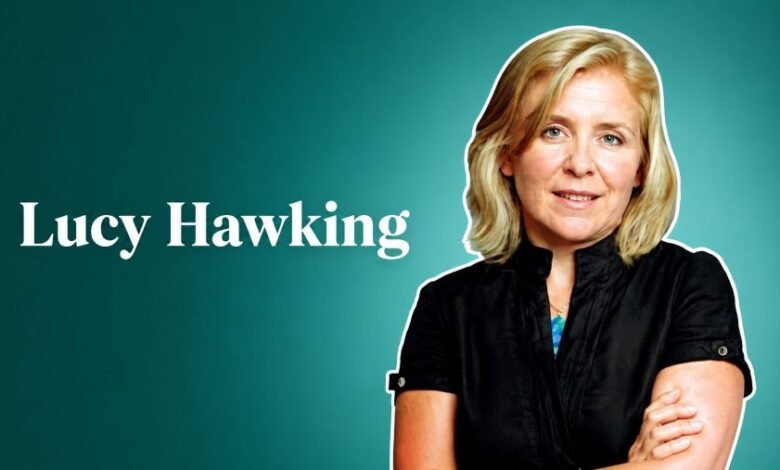
Lucy Hawking is a British author, former journalist, science educator and public speaker. She is widely recognised for creating educational adventure stories that make physics, space and climate science easier for children to understand.
She is also the daughter of theoretical physicist Stephen Hawking and writer Jane Hawking. However, Lucy has developed an independent career through journalism, children’s literature, educational projects and international science communication.
Lucy Hawking is best known for co-creating the George science-adventure book series with her father.
Quick Bio
| Detail | Information |
|---|---|
| Full Name | Catherine Lucy Hawking |
| Known As | Lucy Hawking |
| Date of Birth | 2 November 1970 |
| Age | 55 years old as of June 2026 |
| Birthplace | England |
| Nationality | British |
| Profession | Author, former journalist, science educator and speaker |
| Famous For | The George science-adventure books |
| Father | Stephen Hawking |
| Mother | Jane Hawking |
| Siblings | Robert Hawking and Timothy Hawking |
| Education | University College, Oxford; City University London |
| Main Subjects | French, Russian and international journalism |
| Children | One son |
| Current Residence | London, England |
| Current Role | Chairperson of the Stephen Hawking Foundation |
Why Lucy Hawking Is Famous
Lucy Hawking became famous for combining real science with imaginative storytelling. Her books allow young readers to explore black holes, planets, space travel, climate change and the origins of the universe through fictional adventures.
Her most recognised work is the George series, which she developed with her father and other leading scientists. The stories introduce difficult scientific ideas without making children feel overwhelmed.
According to her official author profile, the six main George adventure novels have been published in more than 40 languages.
Her success comes from showing that science does not have to be dry or frightening. It can be creative, emotional, adventurous and connected to everyday life.
Early Life and Family Background
Lucy was born in England on 2 November 1970. She grew up mainly in Cambridge in a family strongly connected with universities, science, literature and public education.
Her father, Stephen Hawking, became one of the world’s most recognised theoretical physicists. Her mother, Jane Hawking, is an author and educator who wrote about family life and her experiences supporting Stephen during his career.
Lucy has two brothers. Robert Hawking is her older brother, while Timothy Hawking is younger than her.
The family home was often visited by researchers and academics. This environment connected Lucy with the world of cosmology that also shaped physicists such as Fay Dowker, who later completed doctoral research under Stephen Hawking.
Childhood in England and America
Lucy spent part of her early childhood in Pasadena, California, while her father worked at the California Institute of Technology.
She attended school there before the family returned to Cambridge. She later studied at Newnham Croft Primary School and the Perse School for Girls.
Lucy developed an interest in reading, theatre, languages and creative writing. One of her teachers encouraged imagination and introduced her to literature and dramatic performance.
During her teenage years, she joined local drama and music groups. These early creative activities helped her understand character, dialogue and storytelling long before she became a published author.
Education at Oxford
Lucy studied French and Russian at University College, Oxford. Her degree allowed her to develop strong language, writing and communication skills.
As part of her studies, she spent several months living in Moscow. The experience improved her Russian and gave her direct knowledge of another society during a period of major political change.
An Oxford tutor reportedly recognised the quality of her written work and suggested that she should consider becoming a professional writer.
After Oxford, she studied international journalism at City University London. This training prepared her to research complicated subjects, interview people and explain information clearly.
Beginning Her Journalism Career
Lucy started her professional career as a journalist rather than a novelist. She contributed to British newspapers and worked across print and radio journalism.
Journalism taught her how to ask direct questions, check facts and turn large amounts of information into understandable stories.
These skills later became important when she began interviewing scientists and transforming their research into material suitable for children.
Her ability to make difficult topics understandable places her within the wider tradition of British science communicators such as Greg Foot, who also connects expert knowledge with ordinary audiences.
First Books for Adult Readers
Before becoming known for children’s science books, Lucy wrote fiction for adults.
Her early novels included Jaded and Run for Your Life. The second book was also published under the title The Accidental Marathon.
These novels allowed her to develop her voice as an independent writer. They also proved that her career was not based only on her family name or her father’s scientific reputation.
Her early fiction focused more on adult life and personal relationships than science. However, the experience strengthened the storytelling skills she later used in children’s literature.
Creating George’s Secret Key to the Universe
Lucy’s biggest career breakthrough came with George’s Secret Key to the Universe, first published in 2007.
She developed the fictional characters, adventure and story structure. Stephen Hawking and other scientists helped ensure that the scientific material remained accurate.
The story follows a young boy named George who discovers a powerful computer capable of creating a doorway into space. His journey introduces readers to planets, stars, black holes and the wider universe.
The book succeeded because it placed real scientific ideas inside an exciting story. Lucy used a communication method also seen in the work of Claudia Hammond, where expert research is explained through clear language and relatable examples.
The George Book Series
The success of the first book led to a complete series of science-adventure novels.
The six main books are:
- George’s Secret Key to the Universe
- George’s Cosmic Treasure Hunt
- George and the Big Bang
- George and the Unbreakable Code
- George and the Blue Moon
- George and the Ship of Time
The books explore subjects such as the Big Bang, artificial intelligence, computer coding, space travel, planets and the future of humanity.
Scientists contributed essays and explanations to different editions. This allowed young readers to enjoy a fictional adventure while also learning from real researchers.
Writing Style and Communication Skills
Lucy’s writing style is clear, imaginative and educational. She avoids filling her stories with difficult scientific language that young readers cannot follow.
Instead, she introduces science through characters, mysteries, danger and discovery. The reader learns because the characters need scientific knowledge to solve problems.
Her work shows a strong understanding of younger audiences. Like children’s presenter and author Gemma Hunt, she uses warmth, energy and simple explanations to keep children interested.
Lucy does not treat children as if they are unable to understand serious ideas. She respects their curiosity while presenting information at an appropriate level.
Principia Space Diary
In 2015, Lucy worked with Curved House Kids and the UK Space Agency to create the Principia Space Diary.
The educational project followed British astronaut Tim Peake’s mission to the International Space Station. Primary-school pupils could complete activities while learning about space, science and life in orbit.
The project combined writing, drawing, scientific investigation and classroom learning.
It was later shortlisted for an education and outreach award connected with the Arthur C. Clarke Foundation.
Unlocking the Universe
Lucy also helped create Unlocking the Universe, a science collection designed for curious younger readers.
The book includes accessible explanations from scientists working in fields such as physics, astronomy, biology, robotics and climate science.
It continues the approach developed in the George books but places greater attention on factual information and expert contributions.
The project reflects her wider goal of bringing science and storytelling together rather than treating them as separate subjects.
Princess Olivia Investigates Series
Lucy later created the Princess Olivia Investigates series, which focuses on climate change and environmental science.
The main character, Olivia, is more interested in becoming a science investigator than living the traditional life of a princess.
The series began with The Wrong Weather and continued with The Sea of Plastic. These stories explore changing weather, ocean pollution and the environmental choices made by individuals and governments.
Her environmental writing connects naturally with modern public science authors such as Merlin Sheldrake, whose work also explores the relationship between nature, scientific discovery and human behaviour.
You and the Universe
In 2024, Lucy worked on You and the Universe, a children’s picture book inspired by Stephen Hawking’s final Earth Day message.
The book encourages children to look at the world with curiosity and ask large questions about Earth, space and humanity.
Lucy helped make the ideas understandable for younger readers, while illustrator Xin Li provided the visual artwork.
The project also allowed her to continue her father’s mission of making science available to people outside universities and research institutions.
Awards and Major Achievements
Lucy received the Sapio Prize for Popularising Science in 2008.
In 2015, Lucy and Stephen Hawking received the UNSW Medal for Science Communication. The award recognised their work introducing important scientific ideas to younger and wider audiences.
Queen Mary University of London awarded Lucy an honorary Doctor of Science degree in 2015 for her contribution to science communication and STEM education.
She has also served as a judge for science-book and education competitions, including the Royal Society Young People’s Book Prize and the Breakthrough Junior Challenge.
Autism Awareness and Charity Work
Lucy is a trustee of the Autism Research Trust and has supported projects that increase public understanding of autism.
In 2017, she worked with Guardian Media Group on The Party, a virtual-reality experience showing a social event from the viewpoint of an autistic teenage girl.
The project demonstrated how bright lights, noise, crowds and social expectations can create sensory pressure.
It was shortlisted in the Social Impact category at the Virtual Reality Awards.
Stephen Hawking Foundation
Lucy serves as chairperson of the Stephen Hawking Foundation.
The organisation works to protect and develop Stephen Hawking’s legacy. Its interests include scientific education, research communication, disability awareness and public engagement.
Lucy’s role allows her to continue supporting the values associated with her father’s public work while developing projects for new generations.
She also represents the foundation at events, educational programmes and public discussions.
Personal Life
Lucy is a mother to one son and has spoken publicly about how her family experience influenced her interest in autism awareness.
She lives in London with her family.
Lucy generally keeps her private life away from publicity. Her public interviews focus mainly on writing, science education, autism research, climate change and her father’s legacy.
Because reliable current information about a spouse or partner is not publicly presented in her professional profiles, those details should not be guessed.
Public Image and Personal Values
Lucy is seen as an intelligent and creative communicator who helps children feel included in scientific conversations.
Her work supports curiosity, evidence, education and equal access to knowledge. She believes that science should not be restricted to researchers or people with advanced qualifications.
She also promotes environmental responsibility. Her recent books encourage young readers to understand that climate, wildlife, oceans and human behaviour are connected.
Her public image is based on education rather than celebrity. She is recognised for meaningful books, school projects, public speaking and charitable leadership.
Current Status in 2026
As of June 2026, Lucy Hawking remains active as an author, science educator, speaker and chairperson of the Stephen Hawking Foundation.
Her newest confirmed book is Princess Olivia Investigates: The Knights of Nature. It was published on 30 April 2026 and is the third main title in the environmental adventure series.
The book explores biodiversity, climate change and the connection between different environmental problems. Publication information is available through Penguin’s official book page.
She continues to use fictional stories, educational resources and live talks to introduce science to younger audiences around the world.
Interesting Facts About Lucy Hawking
- Her full name is Catherine Lucy Hawking.
- She studied French and Russian at Oxford.
- She spent part of her university course living in Moscow.
- She began her career as a journalist.
- Her first published novels were written for adults.
- The George series has appeared in more than 40 languages.
- She received an honorary Doctor of Science degree in 2015.
- She chairs the Stephen Hawking Foundation.
- She has supported autism research and awareness.
- Her current children’s series focuses on climate and environmental science.
Conclusion
Lucy Hawking has created an inspiring career by connecting science with imagination. Although she grew up in a famous academic family, she developed her own professional identity as a journalist, author, educator and public speaker.
The George books made astronomy and physics exciting for young readers, while her later work has introduced children to climate change, biodiversity, ocean pollution and environmental responsibility.
Her career shows that storytelling can be a powerful educational tool. By placing accurate science inside memorable adventures, Lucy Hawking continues to inspire children to ask questions about the universe and the world around them.
Frequently Asked Questions
Who is Lucy Hawking?
She is a British author, former journalist and science educator known for writing science-adventure books for children.
What is Lucy Hawking’s full name?
Her full name is Catherine Lucy Hawking.
When was Lucy Hawking born?
She was born on 2 November 1970.
Who are Lucy Hawking’s parents?
Her parents are physicist Stephen Hawking and writer Jane Hawking.
What did Lucy Hawking study?
She studied French and Russian at Oxford before training in international journalism.
What is Lucy Hawking famous for?
She is famous for the George science-adventure series created with her father.
Does Lucy Hawking have children?
Yes, she has one son.
What is Lucy Hawking doing now?
She writes children’s books, gives science talks and chairs the Stephen Hawking Foundation.