A roof problem becomes stressful because the wrong choice is expensive. A small repair can protect a healthy roof, but a cheap patch on a failing roof can hide rot, leaks, brittle shingles, and underlayment damage. The experienced solution is to check roof age, damage spread, shingle flexibility, decking condition, leak history, storm proof, and repair cost before choosing.
Roof Repair vs Replacement
This choice is not only about today’s price. It is about whether the roof can safely hold another repair. The strongest decision comes from checking the roof surface, hidden decking, leak pattern, and long-term cost together.
| Key Decision Factor | When to Repair | When to Replace |
| Roof age | The roof is newer with useful life left | The roof is old or near its expected lifespan |
| Damage spread | One small section is affected | Damage appears across multiple areas |
| Shingle condition | Shingles are flexible and flat | Shingles are brittle, curled, or cracked |
| Decking condition | Decking is dry, solid, and hidden | Decking is exposed, gray, soft, or sagging |
| Leak pattern | One clear leak source is found | Leaks return in different areas |
| Repair history | First repair or rare issue | Several repairs have already failed |
| Storm proof | Recent damage is documented | Damage looks old or neglected |
| Cost logic | Repair cost is low and controlled | The repair cost is close to replacement value |
When to Repair? Small Damage That Still Has Life
Repair is the right move when the roof is still fundamentally strong. The problem should be limited, recent, and easy to trace. The surrounding shingles and decking must still support a clean fix.
Choose roof repair when only a few shingles are missing. This is especially true if the rest of the roof lies flat, seals well, and has no wide cracking. A small wind-damaged section can often be restored without disturbing the whole roof.
Repair also works when the leak source is obvious. A damaged pipe boot, loose flashing, chimney gap, or single lifted shingle area can often be fixed directly. The important point is that water should not be spreading beneath the roof surface.
A younger roof usually deserves repair first. If the roof still has many serviceable years left, replacing everything can waste money. A precise repair protects the original investment without creating unnecessary cost.
Use repair when these signs match:
- Damage is local, not spread over several roof faces.
- Shingles are flexible, not snapping when lifted.
- Decking is dry, not soft, gray, or exposed.
- Underlayment is intact, not torn or weathered.
- Leak source is clear, not hidden across multiple areas.
- Repair cost is controlled, not close to replacement value.
A temporary patch can also help during a budget emergency. It can stop active water entry while the owner plans the proper next step. But it should be treated as short-term control, not a permanent fix for a weak roof.
When to Replace? Signs Your Roof Is Losing Value
Replacement becomes the better choice when the problem is no longer isolated. Once the roof starts failing as a system, each patch only protects one weak point. The next storm may expose another failure somewhere else.
Choose roof replacement when the roof is old and showing widespread surface failure. Curling, cracking, missing granules, lifted tabs, and brittle edges mean the material is losing strength. A new patch cannot make surrounding old shingles young again.
Replacement is also stronger when leaks keep returning. One leak can be repaired, but repeated leaks in different rooms show a larger waterproofing problem. That pattern often means the underlayment, flashing, or roof surface is failing together.
The roof structure matters more than the surface appearance. If the roofline sags, attic wood is stained, or decking feels soft, the problem has moved below the shingles. A surface patch cannot restore damaged wood.
Replacement is usually safer when:
- The roof is near the end of life.
- Leaks keep returning after repairs.
- Damage covers multiple roof slopes.
- Shingles are brittle, curled, or cracked.
- Decking is exposed, gray, or rotten.
- Previous patches are failing.
- Repair quotes keep increasing.
- Storm damage is too widespread to isolate.
A full replacement costs more upfront. It also allows the roofer to remove hidden damage, inspect the deck, replace rotten wood, improve ventilation, and install new waterproofing. That is why replacement can be a better financial decision when the roof is already failing.
Brittle Shingles: Why a Patch Can Crack More?
Many homeowners count missing shingles only. Experienced roofers check whether the surrounding shingles can lift without breaking. That test often decides whether repair is realistic.
Brittle shingles are hard to repair cleanly. A roofer may need to lift nearby shingles to remove nails and slide new material into place. If the surrounding shingles crack during that process, the repair can create more weak points.
Older 3-tab shingles often create this problem. They may look acceptable from the ground, but they can split when touched. This is why roofers may recommend replacing a slope instead of patching only the missing pieces.
Ask these questions before approving a patch:
- Can nearby shingles lift without cracking?
- Can the repaired area reseal properly?
- Will nails hold without splitting the material?
- Will new shingles sit flat against old ones?
- Will the patch survive the next strong wind?
If shingles fail these checks, replacement becomes more logical. A patch may still buy time if money is tight. But it should be explained as temporary risk control, not a full roofing solution.
Exposed Decking: The Hidden Red Flag on Roofs
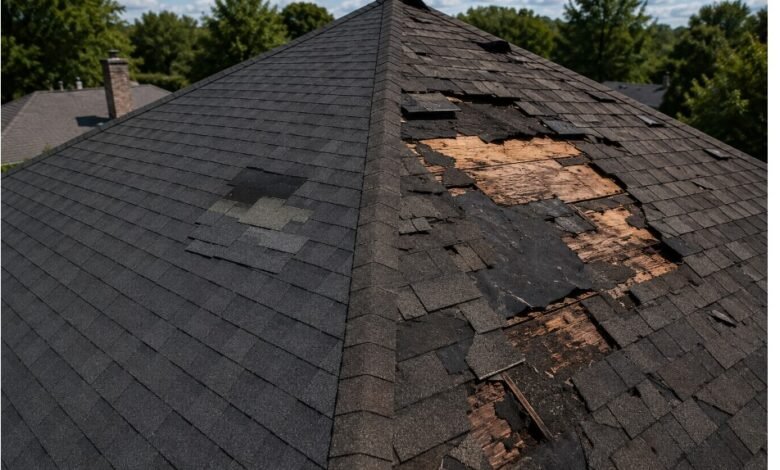
Exposed decking changes the decision quickly. When wood is visible, the protective roof layers are already missing in that area. If the wood is gray or weathered, the damage may have been exposed for longer than expected.
This matters because decking holds the roofing system together. Soft or rotten decking cannot hold fasteners properly. Even a new shingle can fail if the wood below it is weak.
A roofer should check the attic when decking is exposed. Stains, damp insulation, nail rust, mold smell, or dark wood marks can reveal hidden moisture. These signs help decide whether repair is enough or replacement is safer.
Do not judge exposed decking by the opening size only. A small visible area may hide larger underlayment damage around it. Water can travel under shingles before showing inside the property.
This is why exposed decking should never be ignored. It may still be repairable if the damage is fresh and the wood is dry. But if the wood is soft, stained, sagging, or weathered, replacement becomes much more likely.
Repeated Leaks: The Costly Pattern to Stop Early
A single leak does not always mean replacement. A leak around one pipe boot, chimney, valley, or flashing point can often be repaired. The concern begins when leaks keep returning.
Repeated leaks usually mean the roof is failing beyond one spot. Water may be entering through weak shingles, failed underlayment, old flashing, or several small openings. Fixing only the visible stain may miss the true source.
A recurring leak can also cause hidden interior damage. Water can travel along rafters, insulation, and ceiling cavities before appearing indoors. That means the stain may not sit directly below the roof opening.
A serious leak inspection should check:
- Roof surface condition
- Flashing and chimney areas
- Valleys and ridge caps
- Pipe boots and vents
- Attic moisture marks
- Decking strength
- Gutters and drainage
- Previous repair locations
If one leak returns after repair, the first fix may have missed the source. If new leaks appear in different rooms, the roof may be aging beyond patching. That is when replacement becomes a protection decision.
Storm Damage: Insurance Can Change the Choice
Storm damage makes the decision more complex. A recent wind or hail event may support repair or replacement, depending on the damage spread. Old wear, delayed reporting, and poor maintenance can weaken the case.
A repair may work after a storm if only one area is affected. Missing shingles on one small section can often be replaced when nearby shingles are flexible. The decking must also be dry and structurally sound.
Replacement becomes more likely when storm damage is widespread. Lifted shingles across several roof faces, hail bruising, torn underlayment, and exposed decking all increase replacement risk. The roof may not be restorable with one patch.
Documentation is important after storm damage. Photos, storm dates, inspection reports, and repair history help separate sudden damage from long-term wear. This matters because insurance decisions often depend on cause and timing.
Do not assume every storm means full replacement. Also do not assume a small patch is enough after major wind or hail. The safest approach is to inspect the whole roof before deciding.
Repair Cost vs Replacement: The Real Money Test
The cheapest quote is not always the best choice. A small repair on a healthy roof is smart. Repeated repairs on a failing roof can become a money trap.
Use the cost test with roof age. A low-cost repair makes sense when the roof is newer and damage is local. The same repair may be wasteful if the roof is already brittle and leaking elsewhere.
Compare the repair quote against future risk. If the repair only stops one leak but the roof has several weak areas, more costs may follow. Replacement can be cheaper long-term when it stops the repeat cycle.
| Situation | Better Direction | Reason |
| One missing shingle area | Repair | Damage is local and simple |
| One flashing leak | Repair | Source can be isolated |
| Brittle shingles across one slope | Replace slope or roof | Patch may break nearby shingles |
| Multiple leaks after repairs | Replace | System may be failing |
| Gray exposed decking | Inspect for replacement | Long exposure risk is high |
| High repair quote on old roof | Replace | Poor return on repair spend |
| Recent storm with proof | Inspect and document | Claim path depends on evidence |
A good roofer should explain the money logic clearly. They should show photos, repair limits, and the expected life of the fix. If the explanation is vague, get another inspection before paying.
Tile, Slate, and Flat Roofs Need Specific Judgement
Different roof types fail in different ways. A repair rule for asphalt shingles may not fit tile, slate, or flat roofing. The material decides how damage spreads and how repairs should be handled.
Tile roofs need careful handling because one broken tile may be simple, but underlayment failure can be serious. Cracked tiles, slipped tiles, mortar failure, and hidden water paths all need proper inspection. For planned upgrades or specialist work, tile roof installation in london is a stronger option than guessing through repeated patching.
Slate roofs often last longer than many other materials. The weak points may be slipped slates, broken slates, nail sickness, flashing failure, or underlayment age. For heritage or premium properties, a specialist slate roofing service in london is safer than a general repair approach.
Flat roofs require another kind of judgement. Ponding water, seam failure, membrane shrinkage, blistering, and poor drainage can make patching unreliable. If the membrane is aged or the deck is damp, flat roof replacement london may be more practical than chasing leak after leak.
The correct decision must match the roof system. A few broken tiles may be repaired, while a failed flat roof membrane may need replacement. A proper inspection should never treat every roof material the same way.
Inspection Steps Before You Pay for Any Roof Work
A roof quote should be based on evidence. A ground-level opinion is not enough when replacement is expensive. The roofer should show what failed and why the recommended work makes sense.
Start with the visible surface. Missing shingles, cracked tiles, lifted edges, granule loss, failed flashing, damaged valleys, and weak ridge caps should be checked. These signs show whether the issue is local or widespread.
Then check the hidden areas. Attic staining, damp insulation, nail rust, poor ventilation, and soft decking can reveal deeper failure. This step prevents paying for a patch that only hides structural damage.
Before approving work, ask for:
- Damage photos
- Decking or attic photos
- Repair limit explanation
- Replacement reason if recommended
- Material match details
- Written scope of work
- Warranty terms
- Storm damage notes
- Hidden damage plan
A clear scope protects the homeowner. It explains what is included, what may cost extra, and what happens if rotten decking appears. This prevents confusion once work begins.
A second opinion is useful when recommendations conflict. If one roofer says repair and another says replace, compare the evidence. The better answer should be supported by photos, roof age, damage spread, and decking condition.
Final Decision: Repair, Replace, or Patch for Now
The best decision follows a simple order. Check the roof age first, then damage spread, then shingle flexibility, then decking, then leak history, then cost. This prevents pressure-based decisions.
Choose repair when the roof is younger and damage is local. The surrounding materials should be flexible, dry, and structurally sound. The repair should solve a clear problem without hiding a bigger failure.
Choose replacement when the roof is old, brittle, exposed, sagging, or repeatedly leaking. Replacement also makes sense when repair costs keep stacking up. At that point, the roof is warning that the system is tired.
Choose temporary patching only for short-term water control. This can help when money is tight or replacement needs planning. It should always come with an inspection and future repair or replacement plan.
The final rule is direct. Repair local damage on a healthy roof. Replace widespread damage on a failing roof. Inspect hidden areas before spending serious money.
Frequently Asked Questions
Can missing shingles be repaired without replacement?
Yes, missing shingles can be repaired when the damage is small and fresh. The surrounding shingles must be flexible and the decking must be dry. If wood is exposed, gray, soft, or wet, replacement may be safer.
Are brittle shingles too risky to patch?
Brittle shingles are risky because they can crack during repair. A roofer may break nearby shingles while lifting them. If brittleness affects wide sections, replacement is usually more reliable.
Does exposed roof decking mean serious damage?
Exposed decking is a serious warning sign. It means the roof has lost protection in that area. If the wood is soft, stained, weathered, or sagging, a surface repair is not enough.
Should I repair a roof that keeps leaking?
A single clear leak can often be repaired. Repeated leaks in different places suggest a wider roof system problem. Replacement may be more practical when repairs keep failing.
Will insurance pay for roof repair or replacement?
Insurance may help when damage comes from a covered sudden event. Wear, age, neglect, and old damage are usually treated differently. Photos, dates, inspection reports, and repair records are important.