How Certified Arborists Handle Large-Scale Commercial Tree Removal Without Disrupting Surrounding Infrastructure

Managing trees in commercial environments is far more complex than typical residential maintenance. Businesses, industrial sites, construction zones, and public infrastructure projects often require careful planning, regulatory awareness, and specialized equipment to handle large or hazardous trees safely. In such contexts, commercial tree removal plays a critical role in maintaining safety, protecting property, and ensuring operational efficiency.
Unlike small-scale tree cutting, commercial projects involve higher risks, larger tree sizes, and more complicated surroundings such as power lines, buildings, parking areas, and public walkways. As a result, this work demands trained professionals, advanced machinery, and strict safety protocols. When done correctly, it not only improves site usability but also reduces long-term liability and enhances the visual and functional value of the property.
Understanding the Scope of Commercial Tree Work
Commercial tree management involves the assessment, trimming, removal, and disposal of trees in business or public-use environments. These operations are often required for construction development, landscape redesign, hazard prevention, or regulatory compliance. Trees that are diseased, dead, structurally unstable, or obstructing development plans may need to be removed to ensure safety and progress.
The complexity of commercial tree removal lies in the scale and environment of the work. Trees in commercial zones are often larger and more mature, with extensive root systems that may interfere with foundations, pipelines, or paved surfaces. Additionally, surrounding infrastructure such as roads, signage, and utilities requires careful coordination to avoid disruption or damage during removal operations.
Professional arborists begin with a detailed site inspection to determine the condition of the tree and identify potential risks. This evaluation helps in deciding whether removal is necessary or if alternative solutions such as pruning or bracing may be sufficient.
Safety Considerations in High-Risk Tree Removal Environments
Safety is the most critical aspect of any commercial tree operation. Large trees can weigh several tons, and improper handling can lead to severe property damage or personal injury. For this reason, trained professionals follow strict safety procedures and use specialized equipment designed for controlled removal.
Before any work begins, the surrounding area is secured to prevent unauthorized access. Warning signs, barriers, and traffic control measures may be implemented depending on the location. Workers also assess environmental conditions such as wind speed, soil stability, and nearby obstacles that could affect the operation.
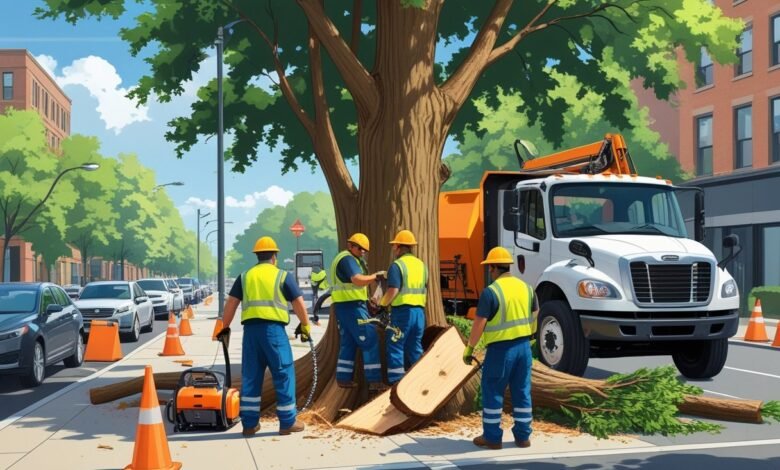
In many cases, trees are removed in sections rather than being felled in a single cut. This technique, known as sectional dismantling, allows arborists to lower branches and trunk segments safely using ropes, cranes, and rigging systems. The precision required in commercial tree removal ensures that surrounding structures remain protected throughout the process.
Equipment Used in Professional Tree Operations
Modern commercial tree services rely on advanced equipment to perform tasks efficiently and safely. Chainsaws, wood chippers, stump grinders, cranes, aerial lifts, and rigging systems are commonly used depending on the complexity of the job.
Aerial lifts allow workers to reach high branches safely, while cranes are often used for extremely large trees or those located in restricted spaces. Rigging systems help control the descent of heavy branches, preventing sudden falls that could cause damage. Wood chippers are used to process debris quickly, reducing waste volume and improving site cleanliness.
Stump grinding equipment is typically used after removal to eliminate remaining root structures. This ensures the land is ready for redevelopment or landscaping. The combination of these tools makes commercial tree removal more efficient and significantly reduces the risks associated with manual cutting methods.
Environmental and Regulatory Responsibilities
Tree removal in commercial settings is often subject to environmental regulations and local authority approvals. Many regions require permits before removing mature or protected trees. These regulations are designed to preserve ecological balance, protect wildlife habitats, and maintain urban greenery.
Professional tree service providers are familiar with these requirements and ensure compliance before beginning any project. In some cases, environmental assessments may be required to evaluate the impact of tree removal on surrounding ecosystems.
Sustainable practices are increasingly important in modern commercial projects. Instead of simply discarding removed trees, companies often recycle wood into mulch, timber, or biomass fuel. This approach reduces waste and supports environmentally responsible operations. Proper planning ensures that commercial tree removal aligns with both development goals and environmental stewardship.
Common Reasons for Tree Removal in Commercial Areas
There are several reasons why trees may need to be removed from commercial properties. One of the most common is safety risk. Trees that are dead, diseased, or structurally compromised can fall unexpectedly, posing a threat to people and property.
Construction and development projects also frequently require tree removal to clear land for new buildings, roads, or infrastructure. In such cases, vegetation must be carefully cleared while preserving surrounding landscape features where possible.
Another reason is interference with utilities. Trees growing too close to power lines, drainage systems, or underground pipelines can create hazards and maintenance challenges. Regular management ensures that such conflicts are avoided.
Aesthetic and functional improvements also play a role. Businesses may choose to remove certain trees to enhance visibility, improve parking space, or redesign outdoor areas for better customer experience. In all these scenarios, commercial tree removal provides a structured and efficient solution,
Proper planning is essential to ensure safe and efficient execution. Arborists conduct detailed risk assessments before initiating any removal work. This includes evaluating tree height, lean direction, structural integrity, and surrounding obstacles.Advanced tools such as drones and mapping software are increasingly used to analyze difficult sites. These technologies help professionals visualize the safest removal strategy and identify potential hazards before physical work begins.Planning also involves determining the best removal method. In open areas, trees may be felled in a controlled direction. In confined spaces, sectional dismantling is preferred. The chosen approach ensures minimal disruption and maximum safety during commercial tree removal operations.
The Role of Skilled Arborists in Complex Operations
Tree removal is not simply a mechanical task; it requires biological understanding and technical expertise. Certified arborists are trained to assess tree health, identify structural weaknesses, and execute removal strategies safely.
Their expertise ensures that decisions are made based on both safety and environmental considerations. They also understand how different tree species behave under stress, which is crucial when planning cuts and rigging techniques.In commercial environments, arborists often work as part of larger teams that include ground crew, equipment operators, and safety supervisors. This coordinated effort ensures that every stage of the operation is controlled and efficient.
Once a tree has been removed, the remaining stump can still pose problems if not addressed properly. Stumps may interfere with construction, attract pests, or create tripping hazards. For this reason, stump grinding or complete removal is typically performed as part of the service.After stump removal, the site is restored to a usable condition. This may involve filling the area with soil, leveling the ground, and preparing it for landscaping or construction. Proper restoration ensures that the benefits of commercial tree removal extend beyond just clearing space; it also prepares the land for its next purpose.
Challenges in Large-Scale Tree Management
Commercial tree projects often face unpredictable challenges. Weather conditions such as strong winds or heavy rain can delay operations or increase risk levels. Urban environments present additional difficulties due to limited space and proximity to infrastructure.Unexpected issues such as hidden decay, root instability, or underground utilities can also complicate removal efforts. These challenges require flexibility, experience, and quick decision-making from the operational team.
Despite these obstacles, professional planning and modern equipment allow most projects to be completed safely and efficiently.Investing in professional tree services provides long-term advantages for commercial property owners. It improves safety by removing potential hazards and enhances the visual appeal of the property. It also supports infrastructure development and ensures compliance with local regulations.
Properly managed landscapes contribute to better customer experience, increased property value, and reduced maintenance costs over time. By addressing risks early, businesses can avoid expensive damage and liability issues.
Conclusion: A Critical Component of Modern Property Management
Ultimately, commercial tree removal is not just about cutting down trees, it is about strategic land management that supports growth, safety, and sustainability.
In today’s fast-growing commercial and industrial environments, efficient land management is essential. Trees, while valuable to the environment, can sometimes pose risks or limitations when they interfere with development or safety requirements.
Through careful planning, skilled execution, and advanced equipment, commercial tree services ensure that these challenges are handled responsibly. From risk assessment to final site restoration, every step is designed to balance safety, efficiency, and environmental care.As businesses continue to expand and urban spaces evolve, the importance of commercial tree removal will only increase, making it a vital part of modern property and infrastructure management.