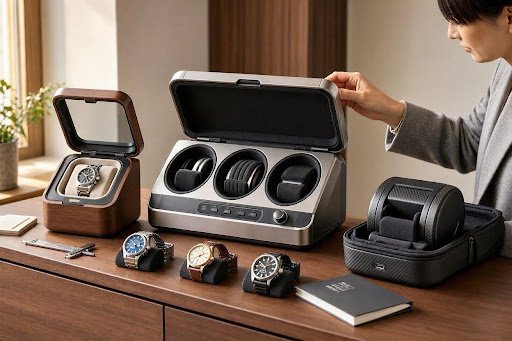
Automatic watches are small mechanical marvels. Unlike quartz watches that run on batteries, they’re powered by the natural movement of your wrist. The trouble starts when you take one off for a few days — the mainspring winds down, and you’re left resetting the time and date all over again. That’s where a watch winder comes in, and it’s why so many collectors eventually add one to their setup.
But not every watch winder is created equal, and buying the wrong one can do more harm than good. If you’re weighing up whether you need one, or you’ve already decided and just want to avoid a costly mistake, here’s a practical guide to help you choose well.
Do You Actually Need a Watch Winder?
Not every automatic watch owner needs one. If you only own a single automatic watch and wear it daily, a winder isn’t necessary — your own movement keeps it running fine. Winders become genuinely useful in a few specific situations:
- You own more than one automatic watch and rotate between them.
- You travel frequently and don’t want to reset complications like the date, moon phase, or perpetual calendar every time.
- Your watch has a complicated calendar function that’s tedious or tricky to reset.
- You want to keep a watch “display ready” in a cabinet without wearing it.
If none of these apply to you, save your money. But if you do fall into one of these categories, a winder can genuinely extend the life of your collection and save you a fair amount of hassle.
Key Factors to Consider Before Buying
1. Rotation Direction (TPD and Direction Settings)
Every automatic movement has its own specifications for how many turns per day (TPD) it needs, and whether it winds clockwise, counter-clockwise, or bidirectionally. Using the wrong setting won’t damage the watch immediately, but it won’t wind it efficiently either — some movements simply won’t wind at all if the direction is wrong. A good winder lets you adjust both TPD and direction, rather than forcing a single fixed setting on every watch you own. If you’re unsure of your watch’s exact specification, most manufacturers list it in the watch’s manual or on their official product page.
2. Motor Quality
This is the single biggest difference between a cheap winder and a good one. Low-quality motors run constantly, which creates unnecessary vibration and wear on the movement over time. Better winders use intermittent “rest and turn” cycles — turning for a short period, then pausing — which mimics natural wrist movement far more closely than continuous rotation. Quiet, low-vibration motors are worth paying a bit more for, especially if the winder will sit in a bedroom or living space.
3. Number of Slots
If you’re only winding one or two watches, a single or double winder is enough. Collectors with larger rotations often go for four, six, or more slots, sometimes with additional static storage compartments for watches that don’t need winding. Think about not just what you own now, but where your collection is likely to go over the next few years — buying a winder with a bit of spare capacity is usually cheaper in the long run than upgrading twice.
4. Build Quality and Materials
A watch winder often sits on display, so material and finish matter almost as much as function. Wood veneers, leather-look finishes, and glass lids all affect both appearance and price. More importantly, check the watch cushion or pillow — it should hold the watch securely without straining the strap or bracelet, particularly for larger sports watches with thicker straps.
5. Power Options
Most winders run on mains power, battery power, or both. Battery-powered options are useful if you want to move the unit around or avoid trailing cables, but batteries need regular replacing, which can be an ongoing cost. Mains-powered units are more reliable for long-term, “set and forget” use.
Weighing Up the Pros and Cons
Like most accessories, watch winders aren’t universally right for everyone. There are genuine benefits — keeping complications set correctly, protecting the mainspring from repeated full unwinding and rewinding, and having a watch ready to wear the moment you pick it up. But there are trade-offs too, including the ongoing cost of electricity or batteries, the small risk of overwinding with a poor-quality unit, and the simple fact that not every watch benefits equally from constant motion. If you want a deeper look at both sides before you commit, this breakdown of the pros and cons of worth considering covers the practical trade-offs in more detail.
Common Mistakes to Avoid
Buying a winder with only one fixed setting. If it can’t be adjusted for TPD or direction, it’s only compatible with a narrow range of movements — and you may find your next watch doesn’t work with it at all.
Choosing based on looks alone. A beautifully finished winder with a poor motor will still wear down your movement faster than a plainer one with proper rest-and-turn cycling.
Ignoring noise levels. If the winder will be in a bedroom, a loud or vibrating motor can genuinely disturb sleep. Read reviews specifically mentioning noise before buying.
Overcrowding the unit. Cramming watches into slots that are too small for their case size can strain straps and bracelets over time.
Assuming every watch needs one. As mentioned earlier, a single daily-wear watch usually doesn’t need a winder at all.
Getting It Right the First Time
The safest approach is to match the winder to your actual collection, not the collection you might have someday. Check the TPD and direction requirements for each watch you own, decide how many slots you realistically need, and prioritise motor quality over decorative finish. If you’re comparing options, it’s worth looking at our range of watch winders, which covers different slot counts and settings suited to varying collection sizes.
For collectors who take their timepieces seriously, a well-chosen winder is a small investment that pays off in convenience and care. A poorly chosen one, on the other hand, is money spent solving a problem it doesn’t actually fix. Take the time to check specifications properly, and you’ll get years of reliable use out of it — a philosophy that runs through everything the Aevitas UK store offers for watch collectors.
For further reading on mechanical movement care and mainspring mechanics, the British Horological Institute is a useful, independent resource for anyone wanting a deeper technical understanding of how automatic watches actually work.
FAQs
Do watch winders damage automatic watches?
Not if used correctly. A quality winder with the right TPD and direction setting for your movement is safe for long-term use. Damage typically comes from cheap winders with fixed, incorrect settings running continuously.
How many turns per day (TPD) does my watch need?
This varies by movement and is usually listed in the watch’s manual or on the manufacturer’s official specification page. It’s worth checking before you buy a winder, rather than guessing.
Can I put a watch with a leather strap in a winder?
Yes, but choose a winder with a properly sized cushion that supports the case without stretching or straining the strap.
Is it better to leave my watch unwound between wears?
For a single daily-wear watch, yes — that’s completely normal. Winders are more useful for watches you wear occasionally or that have complications worth keeping set.
How long should I run a watch winder each day?
This depends on the movement’s TPD requirement, but most quality winders use programmed rest-and-turn cycles rather than running constantly, which is gentler on the movement.
Do all watch winders fit all watch sizes?
No. Larger sports watches or watches with thick straps need winders with correspondingly sized cushions or slots, so it’s worth checking dimensions before buying.
Is a more expensive watch winder always better?
Not necessarily, but price often reflects motor quality and adjustability, both of which matter more than finish or appearance for long-term watch care.