Knowing what a four ton auto body repair kit cannot fix is worth more than knowing what it can

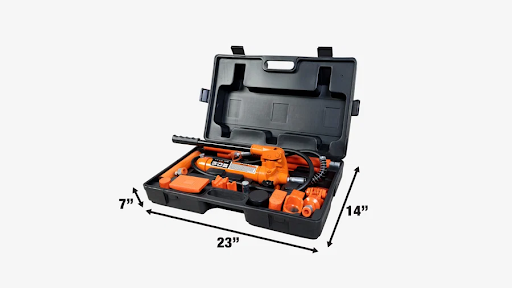
The limit of the tool is the part nobody explains
Late summer is when Canadian owners finally deal with the dent that has been there since spring. An auto body repair kit rated at four tons will move a surprising amount of steel, and the skill worth having is knowing which damage it should be pointed at and which it should not.
The force in an auto body repair kit is indiscriminate. It will push whatever it is aimed at, including panels that have already been damaged past the point where pushing helps, and the result is a repair that looks acceptable for a season and then reappears.
Sheet steel has a memory, and it runs out
Metal deformed gently will spring back toward its original shape when the force is removed, which is what makes a slow push work at all. Beyond a certain strain the change becomes permanent, and the panel keeps the new shape rather than the one it started with.
That threshold is what an owner holding an auto body repair kit is really judging. A smooth, shallow deflection over a wide area is still holding most of its memory, while a sharp crease has passed the limit along the fold line and will never come back cleanly no matter how much force is applied.
A crease is stretched metal, and stretched metal has nowhere to go
Folding a panel makes the metal along the crease longer than it was. Pushing it flat again does not shorten it, so the extra length has to appear somewhere, usually as an oil can effect that flexes under a thumb or as a low ripple beside the repair.
This is why body shops shrink metal with heat rather than only pushing it. Without that step an auto body repair kit can restore the shape of a creased panel without restoring its behavior, and the panel will keep moving every time the door is closed.
Modern panels are not the mild steel these tools grew up with
Vehicles built in the last two decades use high strength and ultra high strength steels in specific places, chosen because they absorb collision energy in a designed way. Those alloys are far less tolerant of being bent back, and many crack rather than stretch when pushed.
Manufacturers publish repair procedures that name these areas and prohibit straightening them outright. The instruction is to cut the section out and replace it at a specified joint, and the reason is that a straightened piece no longer collapses the way the design intended.
Aluminum behaves differently again
Aluminum panels work harden quickly and have far less ability to be reshaped cold. A push that would be routine on a steel fender puts an aluminum one closer to cracking, and repairs on aluminum bodies belong to shops set up for them rather than to a garage floor.
Where the tool is genuinely the right answer
Older vehicles, farm trucks, trailers, and equipment bodies are mostly mild steel with no engineered crush zones and no procedure forbidding anything. On those, an auto body repair kit does exactly what it was designed to do, and the results last.
The other honest use is rough alignment. Pushing a bent bumper mount or a distorted door opening back close to square, so that a panel replacement will actually fit, is a job worth doing even when the panel itself is beyond saving.
Most of these kits spend their lives outside bodywork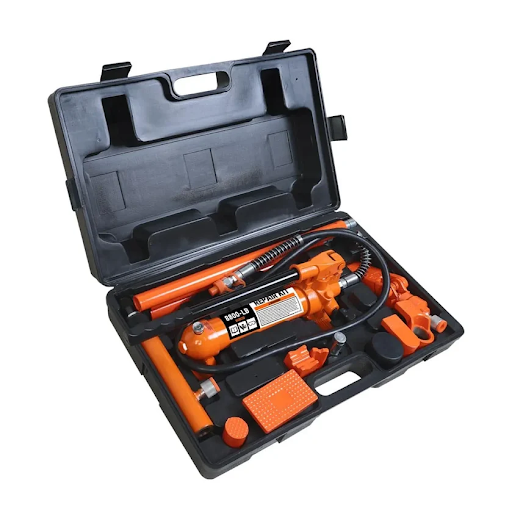
A hydraulic ram is a general purpose pushing tool with a spread of extensions. Spreading a seized bracket, straightening a bent implement frame, forcing a stuck bearing housing apart, and lifting machinery for a moment are all jobs it does without anyone thinking about panels.
Damage divides by what the metal has already done
- Smooth deflection: still elastic, pushes back out
- Sharp crease: stretched, needs shrinking as well
- Engineered structure: replace at the designed joint
Where a portable kit earns its case and where it stops
- Strength: real force anywhere a bracing point exists
- Strength: one case covers machinery as well as panels
- Limit: cannot shorten metal that has been stretched
- Limit: modern structural sections are off limits
Weighed against a body shop, a kit costs the finish quality and returns work an owner can do on a driveway before winter. A farmer near Lethbridge keeps his for equipment and takes the truck to a shop, which is the split most people arrive at eventually.
Repair procedures are increasingly written by the manufacturer
As vehicle structures become more specialized, the question of whether a section may be straightened has moved from the judgement of the person holding the tool to a published document, and owners doing their own work are learning to check it first.
That shift toward documented limits is why the automotive equipment TMG Industrial supplies is most at home on the older vehicles and working machinery where the operator still gets to decide.
READ ALSO: Conversational AI vs. Cognitive AI: How Enterprise Automation Is Growing Up