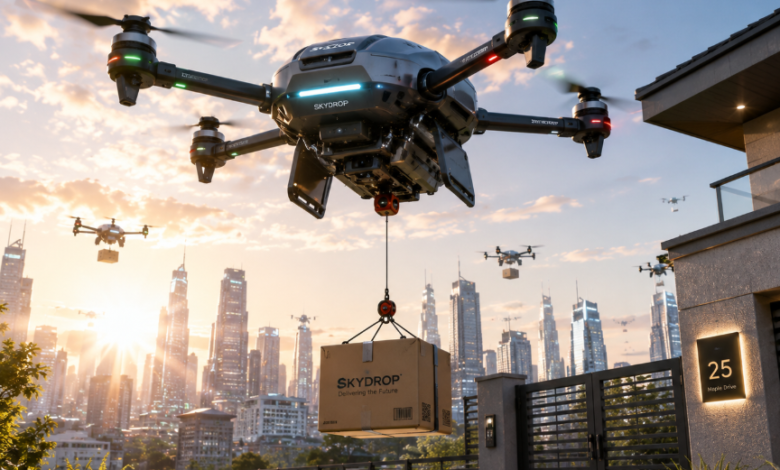
Delivery drones are quickly transforming from a futuristic concept into a practical logistics tool. As technology improves and regulations evolve, these unmanned aerial vehicles (UAVs) are increasingly being used to transport goods, medicine, and food directly to customers—often reducing delivery times from hours to just minutes.
Delivery drones are unmanned aerial vehicles (UAVs) designed to transport parcels, documents, or small freight over short to medium distances. They rely on GPS navigation, onboard sensors, and automated flight control systems to operate with minimal or no human intervention. By flying above road congestion, delivery drones bypass traffic delays, reduce lead times, and reach remote or inaccessible areas. This makes them particularly valuable for last-mile logistics and emergency shipments.
Whether you are a logistics professional, an e‑commerce business owner, or simply curious about the technology, this comprehensive guide explains what delivery drones are, how they work, and what the future holds for commercial drone delivery.
What Are Delivery Drones?
A delivery drone is an unmanned aerial vehicle (UAV) specifically engineered to transport packages from one point to another autonomously. Unlike standard consumer camera drones, delivery drones are built for payload capacity, endurance, and reliability.
These drones are not just flying gadgets — they are highly specialized aircraft integrated with:
- GPS and RTK positioning for precise navigation
- LiDAR, cameras, and ultrasonic sensors for obstacle detection
- AI‑driven flight controllers for autonomous decision‑making
- Secure cargo mechanisms such as winches, drop boxes, or locking compartments
Key Capabilities
| Feature | Typical Specification |
| Payload capacity | 0.5 kg – 150 kg (depending on model) |
| Flight range | 5 – 45 km per mission |
| Flight speed | 10 – 20 m/s (36 – 72 km/h) |
| Operation modes | Autonomous, semi‑autonomous, manual override |
| Navigation technology | GPS, GLONASS, BeiDou, LiDAR, computer vision |
The global market for delivery drones was valued at approximately $2.88 billion in 2025** and is projected to reach **$8.38 billion by 2030, growing at a CAGR of 23.6%. The drone package delivery segment is expected to grow even faster, from $4.4 billion in 2025 to $6.36 billion in 2026 — a CAGR of 44.7%.
Types of Delivery Drones
Not all delivery drones are the same. Depending on the mission, operators choose from three primary types.
Multicopter Drones (Quadcopters & Octocopters)
Best for: Short‑distance, last‑mile deliveries in urban environments.
Pros: Vertical takeoff and landing (VTOL), ability to hover, high maneuverability in confined spaces.
Cons: Limited range and battery life, lower efficiency for long hauls.
Multicopters are the most common type of delivery drone, especially for e‑commerce and local logistics. Their ability to hover precisely makes them ideal for rooftop or doorstep landings.
Fixed‑Wing Drones
Best for: Long‑range deliveries over rural or remote areas.
Pros: High speed, long endurance (can fly over 100 km), energy‑efficient.
Cons: Requires runway or catapult launch; cannot hover.
Fixed‑wing drones resemble small airplanes. They are excellent for covering large distances quickly and are often used in healthcare logistics — for example, delivering blood or vaccines to remote clinics.
Hybrid VTOL Drones
Best for: Versatile operations requiring both long range and vertical landing.
Pros: Take off and land vertically like a multicopter, then transition to efficient fixed‑wing flight.
Cons: More complex design, higher cost.
Hybrid VTOL drones offer the best of both worlds — the agility of a rotorcraft with the efficiency of a fixed‑wing aircraft. Many advanced logistics companies are moving toward VTOL platforms for maximum operational flexibility.
Comparison Summary
| Type | Payload | Range | Hover Capability | Best Application |
| Multicopter | Light–medium (≤ 30 kg) | 5–20 km | Yes | Urban last‑mile |
| Fixed‑wing | Light (≤ 10 kg) | 50–150 km | No | Rural/medical logistics |
| Hybrid VTOL | Medium–heavy (≤ 150 kg) | 30–80 km | Yes | Versatile, mid‑to‑long range |
Core Technology — How Delivery Drones Work
A delivery drone is a sophisticated system of hardware and software working in harmony. Here is a breakdown of the essential components.
Navigation & Positioning
Delivery drones use multiple positioning sources:
- GPS / GNSS (GPS, GLONASS, BeiDou, Galileo) for primary navigation
- RTK (Real‑Time Kinematic) positioning for centimeter‑level accuracy
- Inertial Measurement Units (IMU) to track orientation and movement
- LiDAR and vision sensors for local positioning when GNSS is unavailable
Once the destination is reached, the drone locates its landing pad using onboard cameras and QR‑code recognition.
Obstacle Detection & Avoidance
Modern delivery drones are equipped with:
- Forward‑facing cameras and depth sensors to detect obstacles ahead
- Ultrasonic or LiDAR sensors for near‑field detection during landing
- AI‑powered pathfinding algorithms that dynamically adjust routes
Advanced systems use Simultaneous Localization and Mapping (SLAM) technology to build real‑time 3D maps of the environment while simultaneously identifying the drone‘s position within it. This is critical for operating in areas with poor GPS coverage, such as dense urban canyons or indoors.
Flight Controller & Autonomy
The flight controller is the drone‘s “brain.” It processes data from all sensors and executes commands. Autonomy levels range from:
- Semi‑autonomous: Operator sets waypoints; drone handles flight stabilization.
- Fully autonomous: AI plans route, avoids obstacles, executes delivery, and returns — all without human intervention.
AI‑driven pathfinding allows drones to adjust paths in real time to avoid obstacles, bad weather, or dynamic urban conditions.
Payload & Delivery Mechanisms
Delivery drones carry cargo in several ways:
- Tethered drop — The drone hovers and lowers the package via a winch and string (used by Wing and Zipline)
- Landing zone delivery — The drone lands at a designated safe spot, releases the package, and takes off
- Parachute drop — Used for rapid delivery over wide areas (Zipline)
- Drop box / locking container — Secure compartment that unlocks upon arrival
Communication & Remote ID
Delivery drones maintain constant communication with ground control via:
- 4G / 5G cellular networks for real‑time telemetry
- Dedicated radio links (e.g., 2.4 GHz / 5.8 GHz) for command and control
- Remote ID broadcast — required by aviation authorities to identify the drone and its operator while in flight
Power & Propulsion
Most delivery drones use high‑density LiPo (Lithium‑Polymer) or solid‑state batteries driving brushless DC motors. Power management systems balance thrust, battery consumption, and payload to maximize endurance. Hybrid designs that combine batteries with small combustion engines or solar cells are emerging for extended range.
The Step‑by‑Step Delivery Process
Here is how a typical delivery mission unfolds from start to finish.
Step 1 — Order Placement
Customers place an order via an e‑commerce platform or delivery app. A nearby distribution hub or micro‑fulfillment center is selected.
Step 2 — Package Loading
At the depot, a worker or automated system loads the package into the drone‘s cargo compartment. The system verifies weight and dimensions.
Step 3 — Pre‑Flight Checklist
The drone‘s onboard systems run automatic diagnostics: battery status, sensor calibration, GPS signal strength, weather conditions, and airspace authorization checks.
Step 4 — Takeoff & Autonomous Navigation
The drone takes off vertically, climbs to a safe cruising altitude (typically below 400 feet / 120 meters), and follows a pre‑planned or AI‑optimized route using GPS, SLAM, and obstacle‑avoidance sensors.
Step 5 — Arrival & Delivery
Reaching the destination, the drone:
- Identifies the designated landing zone or drop point using onboard cameras.
- Executes the delivery method (tethered drop, landing, or parachute).
- Captures a proof‑of‑delivery image or scans a QR code.
Step 6 — Return & Landing
The drone returns to its home depot or proceeds to the next delivery point. Upon landing, the operator unloads any remaining cargo and begins battery charging or replacement.
Key Applications of Delivery Drones
E‑Commerce & Retail Delivery
Retailers and e‑commerce giants use drones for rapid, same‑day delivery of small packages. The Wing & Walmart partnership, for example, has launched the world‘s largest retail drone delivery expansion, delivering over 60,000 eligible items — including groceries, household essentials, and OTC medicines — in under 19 minutes, compared to the typical 60‑minute road‑based cycle.
Healthcare & Medical Logistics
This is one of the most mature and impactful applications. Drones deliver:
- Blood products and plasma
- Vaccines and temperature‑sensitive medicines
- Diagnostic samples between hospitals
- Emergency medical supplies to disaster‑stricken areas
Companies like Zipline have successfully deployed medical drone delivery networks in Africa and are now expanding into suburban U.S. markets.
Food & Grocery Delivery
Delivery drones can bring hot meals and groceries directly to customers‘ homes, bypassing traffic and reducing delivery windows from 30–60 minutes to 5–15 minutes.
Industrial & Spare Parts Logistics
Manufacturing plants and warehouses use drones to transport urgent spare parts, tools, and documentation between facilities, reducing downtime.
Emergency & Disaster Relief
In the aftermath of natural disasters — when roads are damaged or blocked — drones provide a lifeline, delivering food, water, medicine, and communication equipment to stranded communities.
Remote Area & Island Supply
Drones ensure logistics continuity for isolated communities (smaller islands, mountain areas) by overcoming geographical barriers.
Challenges Facing Delivery Drones
Despite rapid progress, several challenges remain.
Technical Constraints
- Limited battery endurance — Most drones can fly only 20–40 minutes under load, restricting range.
- Payload capacity — Most delivery drones carry 5 pounds (∼2.3 kg) or less; heavier loads require larger, more expensive platforms.
- Weather sensitivity — High winds, heavy rain, thunderstorms, and dense fog can prevent safe operations.
Regulatory Hurdles
- Beyond Visual Line of Sight (BVLOS) operations remain restricted in many countries. Most drone deliveries require the pilot to maintain direct visual contact with the aircraft.
- Airspace authorization is required for flights in controlled airspace near airports.
- Remote ID compliance is mandatory for drones over 250g in many jurisdictions
In the US, the FAA regulates drone delivery primarily through Part 107 (for standard operations) and Part 135 Air Carrier Certification for large‑scale BVLOS deliveries. In Europe, EASA‘s U‑space framework is creating dedicated digital airspace for drones.
Public Acceptance & Safety
Concerns about noise, privacy (cameras recording ground activity), and safety (risk of falling packages or mid‑air collisions) must be addressed. Early programs focus on transparent community engagement and rigorous safety testing.
Economic Sustainability
While theoretical cost savings can be significant — studies suggest UAVs could reduce last‑mile delivery emissions by 71% and costs by 96.5% compared to truck delivery — achieving financially sustainable operations at scale remains a challenge.
Jinghong Delivery Drones — Industrial‑Grade Logistics Solutions
For businesses requiring heavy‑lift, long‑endurance, and weather‑resistant cargo drones, Jinghong Drone offers a range of professional delivery solutions.
Jinghong delivery drones are designed for industrial logistics, emergency response, and remote area supply. Key models include:
JH HL300 High Payload Transport Drone
- Maximum payload: 150 kg (rated load 120 kg)
- Flight time (no load): 62 minutes
- Max range (no load): 44.6 km
- Range with 100 kg load: 23 minutes / 13.8 km
- Waterproof rating: IP67 — protected against dust, rain, and harsh conditions
- H12 Pro controller: Android touch display, 10 km control range
JH M400 Transportation Drone
- Industrial‑grade hexacopter / octocopter design
- 180 kg rated payload, flight speeds up to 15 m/s
JH LD441 Long‑Endurance Drone
- 60 minutes maximum flight time
- 2.5 kg payload capacity, covering up to 5 km per mission
- Ideal for light cargo and rapid last‑mile deliveries
Why Choose Jinghong for Delivery Drones?
- Industrial durability — Carbon fiber and aerospace aluminum frames
- Weatherproof (IP67) — Operates in rain and dusty conditions
- Flexible payload integration — Drop boxes, release hooks, thermal cameras, megaphones
- Deployed in over 30 countries — Including USA, Poland, France, Russia, Mexico, Brazil, Australia, and multiple EU markets
For businesses looking for heavy‑lift cargo capabilities without paying premium prices, delivery drones for sale from Jinghong represent outstanding value.
Frequently Asked Questions (FAQs)
Q1: What is a delivery drone?
A: A delivery drone is an unmanned aerial vehicle (UAV) designed to transport packages, medicine, food, or other goods from one location to another, operating autonomously or semi‑autonomously using GPS, AI, and onboard sensors.
Q2: How far can delivery drones fly?
A: Range depends on the drone type. Multicopters typically cover 5–20 km, fixed‑wing drones can fly 50–150 km, and high‑end industrial cargo drones like the Jinghong JH HL300 can achieve up to 44.6 km without load.
Q3: How much weight can a delivery drone carry?
A: Consumer‑grade delivery drones carry 0.5–5 kg (1–11 lbs). Industrial logistics drones can carry significantly more — for example, the Jinghong JH HL300 supports up to 150 kg payload.
Q4: Are delivery drones legal?
A: Yes, but subject to regulations. In the US, commercial drone operators must hold an FAA Remote Pilot Certificate (Part 107). Large‑scale BVLOS deliveries require Part 135 Air Carrier Certification. Always check local aviation authority rules before operating.
Q5: How do delivery drones avoid obstacles?
A: Delivery drones use a combination of cameras, LiDAR, ultrasonic sensors, and AI‑powered pathfinding algorithms. Advanced systems use Simultaneous Localization and Mapping (SLAM) to build real‑time 3D maps and avoid dynamic obstacles.
Q6: How long does a delivery drone battery last?
A: Flight times vary from 15–30 minutes for consumer models to 60+ minutes for industrial drones. Heavy payloads reduce battery life. Fast‑charging systems (e.g., 60A charging) can minimize downtime between missions.
Q7: What happens if a delivery drone loses GPS signal?
A: Modern delivery drones use SLAM technology and onboard vision sensors to navigate even when GPS is unavailable. They can continue using visual odometry, LiDAR, and inertial data until GPS is restored.
Q8: Can delivery drones fly in rain or wind?
A: Industrial‑grade drones often have IP ratings (e.g., IP67) for dust and water resistance. However, operators should avoid high winds, heavy rain, thunderstorms, and dense fog to ensure safety. Always check weather conditions before flight.
Q9: How much do delivery drones cost?
A: Consumer delivery drones start around $3,000–$5,000. Industrial cargo drones with heavy payload capacities (50–150 kg) range from $10,000 to $40,000 depending on specifications.
Q10: Which companies use delivery drones today?
A: Leading operators include Zipline (medical logistics), Wing (Alphabet/Google), Amazon Prime Air, Walmart, Flytrex, Drone Delivery Canada, and DHL. In Asia, Meituan and Alibaba are also active.
Conclusion
Delivery drones are no longer a speculative technology — they are actively reshaping last‑mile logistics, healthcare supply chains, and e‑commerce fulfillment. By combining advanced navigation systems, AI‑powered autonomy, and robust hardware, these UAVs deliver packages faster, cleaner, and often more cost‑effectively than traditional ground transportation.
However, successful drone delivery depends on choosing the right platform for your needs. Multicopters excel in urban last‑mile logistics, fixed‑wing drones dominate long‑range rural deliveries, and hybrid VTOL drones offer the ultimate versatility.
For logistics operators, e‑commerce businesses, and emergency services requiring heavy‑lift, long‑endurance cargo capabilities, Jinghong delivery drones provide industrial‑grade performance with IP67 weatherproofing, payloads up to 150 kg, and flight ranges exceeding 40 km — all at highly competitive price points.
Whether you are looking to launch a local delivery service or upgrade your logistics network, understanding what delivery drones are and how they work is the first step toward leveraging one of the most transformative technologies of the decade.