Sawing is the fast part of the day
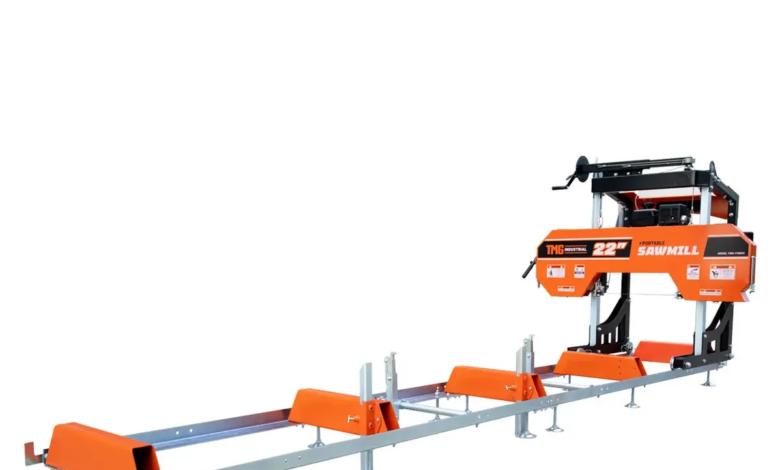
American landowners spend the end of summer converting storm damage into something useful. Time a weekend with a portable sawmill and the cutting itself accounts for perhaps a third of it, while the rest goes to moving logs, moving boards, and walking between the two.
That ratio is set by the layout around a portable sawmill rather than by the machine. A mill placed thoughtfully turns handling into a short push, and a mill dropped wherever the trailer stopped turns every board into a walk with something heavy in both hands.
The word portable persuades people to set up in the wrong place
A portable sawmill that can be taken to the log seems to argue for setting up in the woods where the tree fell. In practice the logs get moved once regardless, and everything else has to be carried out of the woods afterward, board by board.
Hard, level ground with vehicle access is worth more than proximity to the timber. A portable sawmill on a driveway or a yard apron can be fed by a tractor, and the lumber leaves on a trailer rather than on somebody’s shoulder.
Services matter more than they appear to. Fuel, bar oil, spare blades, and a way to sharpen them all need somewhere dry and close by, and a site that means walking to a shed for every small thing loses an hour across a day without anyone noticing where it went.
Three zones, arranged in the order material flows
Logs wait on one side, the portable sawmill sits in the middle, and cut lumber stacks on the other. Set up that way, every piece moves forward and nothing crosses its own path, which sounds obvious and is the arrangement almost nobody achieves by accident.
There is a fourth pile nobody draws on the plan. Slabs and edgings come off every log and are bulkier than the lumber, so a spot for them has to exist from the start or they end up ringing the mill and blocking the path the operator uses most.
The log deck should be higher than the mill bed
A log that can be rolled downhill onto the bed is a log nobody has to lift. Even a slight fall makes the difference, and a pair of skids running from a raised deck turns the heaviest task of the day into something one person can manage alone.
Getting logs onto that deck is its own arrangement. A tractor with forks, a winch anchored to a tree, or a ramp built from two poles all work, and whichever it is should be set up before the first log arrives rather than improvised around it.
Lumber needs somewhere to go the moment it comes off
Boards left leaning against the mill get in the way within the first hour. Having the stickers cut and the stack bearers already set means a board goes straight from the saw to its final position, which is also the position where it will dry properly.
Air has to reach the stack once it is built. Bearers off the ground, stickers between every layer, and a gap on the windward side are what turn a pile of wet boards into dry lumber, and a stack built tight against a wall dries on one face only.
Working alone changes where everything goes
With help, a board can be handed off and the site can be spread out. Alone, every distance is walked twice, and the layout has to be tight enough that the operator can reach the log deck, the mill, and the stack without ever putting a board down halfway.
Mill sites divide by what is nearby
- In the woods: short log haul, long lumber haul
- Yard with access: everything arrives and leaves by vehicle
- Beside the build: no lumber handling at all
Where a considered setup pays and where it does not
- Strength: handling drops to a fraction of the day
- Strength: lumber stacks correctly the first time
- Limit: a good site may be far from the logs
- Limit: level hard ground is not always available
Weighed against setting a portable sawmill up beside the tree, a permanent yard site costs a log haul and returns a working area that suits every job afterward. A woodlot owner in Maine built a gravel pad and now mills alone in a day what used to take two people.
Small scale milling is becoming a fixture rather than an event
Owners who once hired a mill for a single job increasingly keep one and work through timber as it becomes available, which has moved the question from how to transport a mill to where it should permanently live.
That shift toward regular use is why the forestry equipment TMG Industrial supplies is built to be set up on a prepared pad as readily as it is moved to a fallen tree.
READ ALSO: What Makes Containerized Water Treatment Systems Essential, and Why Choose QILEE?